The Unstoppable Ascent: How the Stock Market Seized the Economic Driver’s Seat
FOR IMMEDIATE RELEASE
July 14, 2026 – A recent analysis of household financial asset allocations reveals a profound and potentially irreversible shift in the global economic landscape: the stock market has ascended to an unprecedented position of dominance, effectively becoming the central arbiter of wealth, policy, and even national stability. What was once a niche pursuit for the wealthy or a conservative component of institutional portfolios has transformed into the primary engine of household savings and a powerful, almost sovereign, entity capable of dictating the actions of governments and central banks.
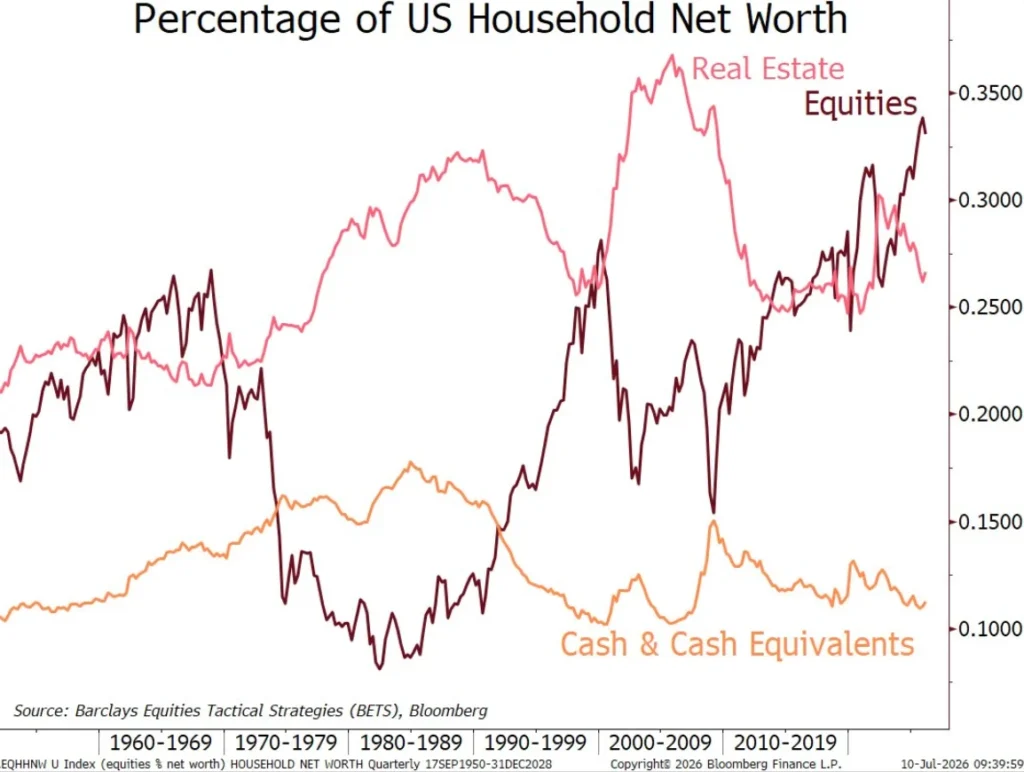
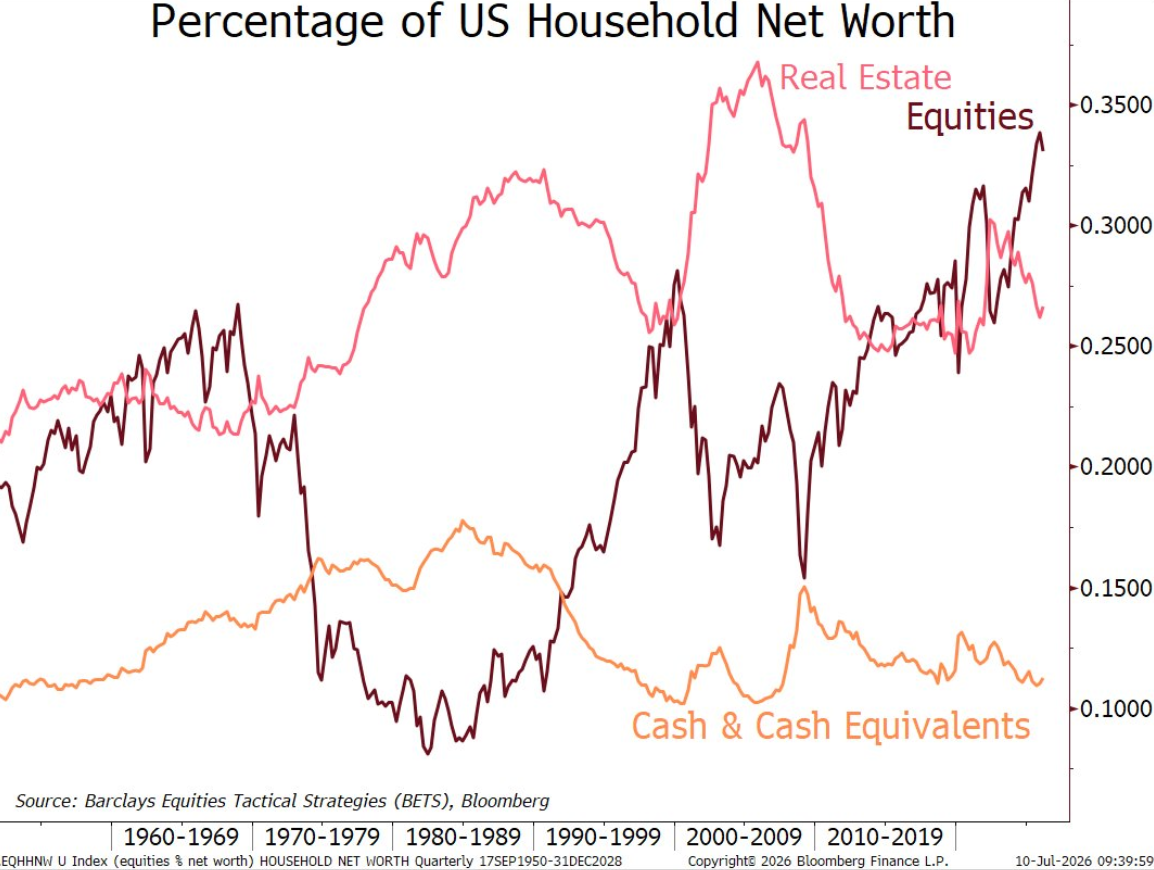
The catalyst for this renewed examination comes from a compelling chart shared by financial analyst Joe Weisenthal, illustrating the historical ebb and flow of household allocations to various financial assets. The visual data, widely circulated, depicts equities now leading by such a significant margin that it prompts a critical question: is this merely another cyclical peak, hinting at overvaluation and an impending correction, or does it signify a fundamental, "new normal" where stock market dominance is an entrenched reality? According to Ben Carlson of A Wealth of Common Sense, the chart acts as a "Rorschach test," inviting varied interpretations, but the underlying trend points to an undeniable and growing influence.
The Main Facts: Equities’ Unprecedented Lead
The core observation is stark: household allocations to equities have surged, dwarfing other asset classes like bonds, real estate, or cash. This isn’t just a marginal lead; it’s a pronounced gap that suggests a structural change rather than a mere market cycle. This widespread embrace of stocks is a relatively modern phenomenon, a stark contrast to previous generations where equity ownership was far less common and often viewed with skepticism.
The United States, despite comprising just 4% of the world’s population and 25% of global GDP, astonishingly accounts for 65% of the world’s stock market capitalization. This disproportionate share underscores the critical role the U.S. market plays not only domestically but internationally, acting as a barometer and often a determinant of global economic health and investor sentiment. This concentration of market power amplifies the implications of its preeminent position in household wealth.
A Chronology of Transformation: From Aversion to Addiction
Understanding the current landscape requires a journey through the evolution of stock market ownership in American households. For much of the 20th century, the equity market was a distant, often intimidating, realm for the average citizen.
The Post-Depression Stigma (Pre-WWII to Mid-20th Century):
In the aftermath of the 1929 crash and the ensuing Great Depression, a deep-seated aversion to stocks permeated American society. As financial historian Peter Bernstein recounted in a 1990s PBS interview, entering the market in 1951 meant encountering a generation of investors scarred by the 1929 experience. These individuals were "terribly conservative," and legal frameworks reflected this caution. Bernstein noted, "you couldn’t put a personal trust more than 35 percent in common stocks in New York. And in some states you couldn’t own any common stocks in any kind of a legal fiduciary." This legislative conservatism, born from a collective trauma, severely restricted institutional and individual equity exposure. Disposable income was also scarcer, and barriers to entry, including high costs and a general lack of market knowledge, further limited participation.
The Era of Defined Benefits (Mid-20th Century):
During this period, pensions, primarily defined benefit plans, played a more significant role in retirement savings. While offering a form of financial security, these plans often acted like bonds for individuals, providing predictable income streams. The plans themselves, however, were relatively conservative investors, often mandated by law or cautious by design to hold a lower proportion of equities compared to today’s standards. This meant that even indirectly, through their employers, many Americans were not heavily invested in the stock market.
The Dawn of Democratization (Late 20th Century):
The paradigm began to shift with the introduction of Individual Retirement Accounts (IRAs) and 401(k) plans. These tax-advantaged defined contribution plans gradually supplanted traditional pensions, placing the onus of investment decisions directly on individuals. This marked a pivotal moment, as millions of Americans, previously reliant on employer-managed pensions, were now incentivized to engage with financial markets, particularly equities, to build their retirement nest eggs. This era slowly began to chip away at the historical aversion, but access and knowledge still presented hurdles.
The Digital Revolution and Hyper-Accessibility (21st Century):
The true acceleration of stock market participation came with the digital age. Online trading platforms emerged, dramatically lowering transaction costs and democratizing access. The subsequent introduction of zero-dollar commissions, robo-advisors offering automated portfolio management, and the widespread adoption of target-date funds further streamlined the investment process. Platforms like Robinhood, with their user-friendly interfaces and gamified approaches, introduced a new generation to trading, making it as simple as "gambling away your life savings at the push of a button," as Carlson vividly puts it. This combination of accessibility, low cost, and ease of use has eradicated many of the historical barriers, transforming investing from a specialized activity into a mainstream pursuit.
Supporting Data: The Pillars of Equity Dominance
Several factors underpin and perpetuate the stock market’s newfound prominence:
- Retirement Security: For many retirees, stocks are no longer an optional growth engine but a crucial hedge against inflation, essential for maintaining purchasing power over decades of retirement. The erosion of traditional pensions means individuals bear more market risk.
- Pension Plan Evolution: Modern pension plans, particularly hybrid and defined contribution models, have drastically increased their equity allocations. Recognizing the need for growth to meet long-term liabilities, these institutional investors are now significant participants in the stock market.
- Youth Engagement: More young people than ever before are directly investing in the markets. Driven by financial literacy initiatives, social media influence, and the sheer accessibility of platforms, younger demographics are entering the market earlier in their careers, building compounding wealth over longer horizons.
- The Automatic Investing Revolution: The rise of automatic investment plans, payroll deductions, and recurring investments means millions of people are consistently funneling money into the stock market, regardless of short-term market fluctuations or economic headlines. This systematic, often passive, inflow provides a powerful and continuous tailwind for equity markets, acting as a self-fulfilling prophecy of sustained demand. This "set it and forget it" approach has created a resilient base of capital inflow that was absent in previous eras.
This confluence of factors has not only increased the number of participants but has also deepened the market’s integration into the fabric of everyday financial life, making it indispensable for individual wealth accumulation and institutional solvency.
Official Responses and the Shadow of Intervention: The "Fed Put" Debate
The increased importance of the stock market has inevitably drawn the attention of policymakers, leading to a profound re-evaluation of how financial crises are managed. The discussion has evolved from merely stabilizing banks to potentially safeguarding equity markets themselves.
The Provocation from Bloomberg:
Bloomberg’s Eric Balchunas recently posed a provocative question: will the Federal Reserve buy stocks during the next financial crisis? This isn’t a speculative musing from the fringes but a serious query from a respected market analyst, reflecting a growing sentiment that the stakes are too high for the Fed to remain aloof from equity market collapses. Balchunas argues that the stock market has become "our retirement fund," and its sheer size and widespread ownership mean its stability is a matter of national economic security. He points to precedents set by central banks in Japan and China, which have already engaged in direct or indirect equity purchases to support their markets, suggesting a roadmap for future U.S. intervention.
Historical Precedents of Market-Driven Policy:
While direct Fed equity purchases remain hypothetical, the market’s power to "force the hand of policymakers" is not. Several recent events demonstrate this leverage:
- The 2008 TARP Vote: In 2008, when the U.S. House of Representatives initially rejected the $700 billion Troubled Asset Relief Program (TARP), the stock market reacted swiftly and brutally, plummeting almost 9% the very next day. This sharp decline sent an unequivocal message to lawmakers, who subsequently reversed course and passed the bailout, demonstrating the market’s capacity to exert immediate, punitive pressure on political decisions.
- COVID-19 Stimulus (2020): The early days of the COVID-19 pandemic saw the stock market fall by an astonishing 35% in a matter of weeks. This precipitous decline was a significant factor in prompting an unprecedented, multi-trillion-dollar government spending spree and aggressive monetary easing from the Fed, designed to stabilize the economy and financial markets. The speed and scale of the response underscored the perceived necessity of preventing a prolonged market collapse.
- Tariff Negotiations: On several occasions, significant drops in the stock market (such as a swift 19% decline over days) have coincided with policymakers walking back or softening contentious tariff policies, indicating that market sentiment can directly influence international trade decisions.
- Geopolitical Influence: Even in geopolitical conflicts, such as those involving Iran, energy price spikes driven by market reactions have played a discernible role in shaping diplomatic and strategic responses, illustrating the pervasive influence of financial markets beyond traditional economic policy.
These examples solidify the argument that the stock market is no longer a passive recipient of economic policy but an active participant, capable of generating its own "official responses" through price action, thereby compelling governments and central banks to act. The "Fed put" – the implicit belief that the central bank will intervene to prevent major market downturns – has become a deeply ingrained expectation among investors, creating a moral hazard but also a powerful self-fulfilling prophecy.
Implications: The Trillion-Dollar Question for the Future
The stock market’s ascension to the "driver’s seat" carries profound implications for the global economy, financial stability, and public policy. The "trillion-dollar question," as Carlson frames it, is what this new normal portends for the future.
Faster Market Cycles and Policy Pressure:
One immediate consequence is likely to be faster corrections and bear markets. The hyper-connectedness of global markets, algorithmic trading, and the instantaneous dissemination of information mean that sentiment can shift rapidly, triggering sharper and more volatile price movements. When markets fall, the pressure on policymakers to intervene will be immense and immediate, given the widespread reliance on stocks for retirement and wealth. This could lead to a cycle where market instability is met with swift, often massive, policy interventions, creating a perception of a "backstop" that encourages further risk-taking.
Unintended Consequences and Moral Hazard:
While the increased accessibility to stocks offers opportunities for wealth creation, it also harbors significant unintended consequences. The expectation of government intervention ("the Fed put") creates a moral hazard, potentially disincentivizing prudent risk management among investors and corporations. If market downturns are consistently met with bailouts or stimulus, the natural cleansing mechanism of the free market—where inefficient companies or overleveraged investors fail—is undermined. This could lead to asset bubbles, misallocation of capital, and an overall increase in systemic risk, as markets become increasingly reliant on external support.
Exacerbated Inequality:
The dominance of the stock market as the primary wealth engine could also exacerbate wealth inequality. Those with significant assets benefit disproportionately from market appreciation and policy interventions designed to support asset prices. Conversely, those without substantial market exposure, or who rely primarily on wages, may find their relative economic position diminishing, leading to social and political tensions.
Erosion of Traditional Economic Principles:
The increasing influence of the stock market on policymaking challenges traditional notions of economic governance. If market reactions dictate policy, rather than careful analysis of fundamental economic indicators or long-term societal goals, there is a risk of short-termism and reactive decision-making. The lines between monetary policy, fiscal policy, and market sentiment become blurred, potentially eroding the independence of central banks and the democratic process itself.
The Reshaping of Investment Behavior:
For individual investors, the "new normal" means a continuous need for education and adaptability. While automatic investing simplifies participation, understanding the inherent risks and the potential for rapid market shifts remains critical. The allure of quick gains in a seemingly "always supported" market environment could lead to speculative bubbles, especially among less experienced investors.
Conclusion: The Stock Market in the Driver’s Seat
The evidence is clear: the stock market has fundamentally transformed from a mere component of the economy into its undisputed conductor. It is now deeply intertwined with household financial security, institutional solvency, and even the direction of national policy. This elevation to the "driver’s seat" marks a definitive "new normal," characterized by heightened market sensitivity, the potential for faster corrections, and an almost certain expectation of intervention from policymakers during times of crisis.
The challenge ahead for investors, regulators, and governments will be to navigate this new landscape with foresight and prudence. While the democratized access to wealth creation opportunities is a positive development, the accompanying risks—moral hazard, systemic vulnerability, and the potential for market forces to override democratic principles—demand careful consideration. Ignoring the stock market’s elevated status is no longer an option; understanding its power and adapting to its demands will be crucial for economic stability and prosperity in the decades to come. The era of fighting the stock market is over; the era of managing its immense power has begun.