From Pasture to Portfolio: How Brazil’s Tokenized Cows Are Revolutionizing Agricultural Finance
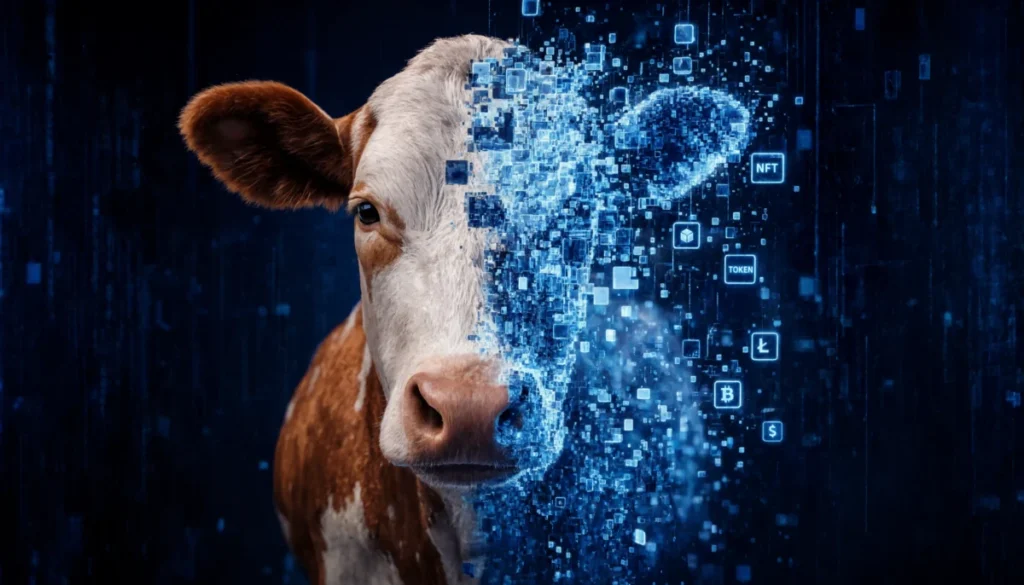
In an unprecedented fusion of high-tech blockchain solutions and traditional livestock farming, ten dairy cows at the Fazenda Engenho Velho in Imbituva, Brazil, have made financial history. These animals are now the first livestock collateral formally registered on the B3, Brazil’s primary stock exchange. This landmark deal represents more than just an innovative use of technology; it is a high-stakes real-world stress test for the burgeoning Real-World Asset (RWA) tokenization movement, potentially offering a lifeline to farmers grappling with an intensifying credit crisis.
The Mechanism: Bridging Blockchain and Biology
The operation centered on a R$100,000 (approximately $19,420) loan secured through a Cédula de Produto Rural Financeira (CPR-F), a specialized rural credit certificate used by Brazilian producers to borrow against future production or current assets. While the instrument is traditional, the collateral backing it is anything but.
The cows were "tokenized" via a proprietary system developed by Cowmed, an agricultural technology startup specializing in AI-driven herd management. Each of the ten cows—collectively valued at R$120,000 ($23,310)—was fitted with a smart sensor collar. These devices continuously track health metrics, behavioral patterns, and geolocation. Using this data, Cowmed generates a unique, encrypted digital ID for each animal. This identifier is cryptographically hashed, creating a tamper-resistant digital twin that is inextricably linked to the credit contract.
By providing real-time verification of the asset’s existence and health, the system removes the traditional need for costly and time-consuming manual farm inspections. The credit was issued by BMP, a central bank-authorized direct credit company, which subsequently sold the credit rights to Target FIDC—a fund specialized in purchasing and monetizing receivables—before registering the entire package on the B3 exchange.
Chronology of the Deal: A Path to Modernization
The journey to this historic registration began as a response to a tightening credit environment in Brazil’s vast agricultural sector.
- Pre-2025: Traditional banking institutions, wary of the inherent risks of livestock—such as health issues, theft, or mortality—routinely applied a 60% haircut on the value of cattle used as collateral. This meant a cow worth R$20,000 on the open market might only secure a loan of R$8,000, severely limiting a farmer’s liquidity.
- Early 2026: As bankruptcy protection requests (recuperação judicial) in the agribusiness sector surged to record highs—reaching nearly 2,000 filings by mid-year—the necessity for a more efficient, data-backed collateral system became critical.
- July 2026: The pilot program at Fazenda Engenho Velho was finalized. The integration of Cowmed’s AI data into the financial ledger allowed for the first-ever B3 registration of tokenized livestock.
- The Future: Following the success of this initial pilot, Target FIDC has moved to evaluate four additional farms. The companies involved have set a goal of facilitating R$5 million (approximately $971,000) in credit through this model by the end of 2026.
Supporting Data: The Agricultural Credit Emergency
The impetus for this innovation is rooted in a sobering economic reality. According to data from Serasa Experian, the Brazilian agribusiness sector faced 1,990 requests for bankruptcy protection in 2025, a nearly four-fold increase from the 534 filings recorded in 2023.
This "slow-motion credit emergency" is the result of a "perfect storm":
- Macroeconomic Pressure: Persistently high interest rates have made traditional debt servicing untenable for many producers.
- Market Volatility: Tumbling commodity prices have compressed profit margins, leaving little room for error.
- Climate Shocks: Increasingly unpredictable weather patterns have made agricultural output less consistent, leading lenders to tighten their criteria for issuing loans.
Against this backdrop, the Cowmed data becomes a powerful tool. The company currently monitors 100,000 cows across 1,200 farms in Brazil, the U.S., Canada, Uruguay, Paraguay, and Bolivia. The total value of the livestock under their monitoring umbrella is estimated at R$2 billion (roughly $395.4 million). Thiago Martins, CEO of Cowmed, projects that within two years, 20% of that herd—representing a potential R$400 million ($77.6 million) in value—could be pledged as tokenized collateral.
Official Perspectives: Shifting the Paradigm
For financial institutions, the shift is driven by a need for transparency. "Banks will increasingly demand real collateral and new information," notes Humberto Brenner, director of Target FIDC. By using sensor-derived data, lenders can finally mitigate the "uncertainty gap" that previously forced them to discount the value of livestock so heavily.
"With monitoring, that uncertainty is eliminated," Brenner told Globo Rural. "We are moving from a system of trust to a system of verifiable data."
Thiago Martins echoed this sentiment, framing the technology as a bridge between the physical and the financial. "We took the cow, a real and tangible asset, and transformed it into a digital asset backed by a unique code monitored in real time," Martins explained to CNN Brazil. "This digitalization allows formal registration on B3 as a financial security—the process gives the farmer an advantageous opportunity to get financing, opening a new collateral alternative at a time of strong credit restrictions."
For the producer, the benefits are practical and immediate. The model offers access to credit with more attractive interest rates and higher borrowing limits, as the "quality" of the collateral is no longer a matter of opinion, but of high-frequency data.
Implications: The Global Rise of RWA Tokenization
The Brazilian experiment is a microcosm of a much larger global trend: the tokenization of Real-World Assets (RWA). This movement involves converting physical assets—ranging from gold and real estate to government bonds and, now, livestock—into digital tokens that can be managed on a blockchain.
According to industry reports, the total value locked (TVL) in RWA tokenization projects has already surpassed $10 billion on various decentralized finance (DeFi) platforms. While much of this activity has been concentrated in liquid assets like U.S. Treasuries, the "hoof-based" model pioneered by Cowmed represents a significant expansion of the sector.
A New Standard for Collateral
The implications for the banking sector are profound. If livestock—a notoriously difficult asset to value and monitor—can be successfully tokenized and traded as a financial security, it opens the door for other sectors. Forestry, grain silos, and even machinery could follow suit, provided the technology exists to provide the same level of granular, real-time data.
Challenges and Regulatory Hurdles
Despite the success of the Imbituva pilot, the model is not without challenges. Legal frameworks for digital assets are still evolving, and the reliance on third-party technology (Cowmed’s sensors) means that the integrity of the data remains the single point of failure. If a sensor fails or is tampered with, the "digital twin" may lose its alignment with the physical asset. Furthermore, scaling this to thousands of farms will require standardized data protocols that all banks, regulators, and exchanges can accept.
Conclusion: A Future of "Agri-Finance"
The successful registration of ten cows on the B3 is a signal that the walls between the "crypto" world and the "real" economy are crumbling. For the Brazilian farmer, the ability to leverage their herd as a verifiable digital asset provides a new weapon against credit exclusion. As the financial sector continues to seek ways to de-risk loans in an era of climate and economic instability, the "tokenized cow" may well prove to be the first of many assets to make the leap from the pasture to the portfolio.