Navigating the AI Frontier: Why Diversification Through the Value Chain is the New Gold Standard

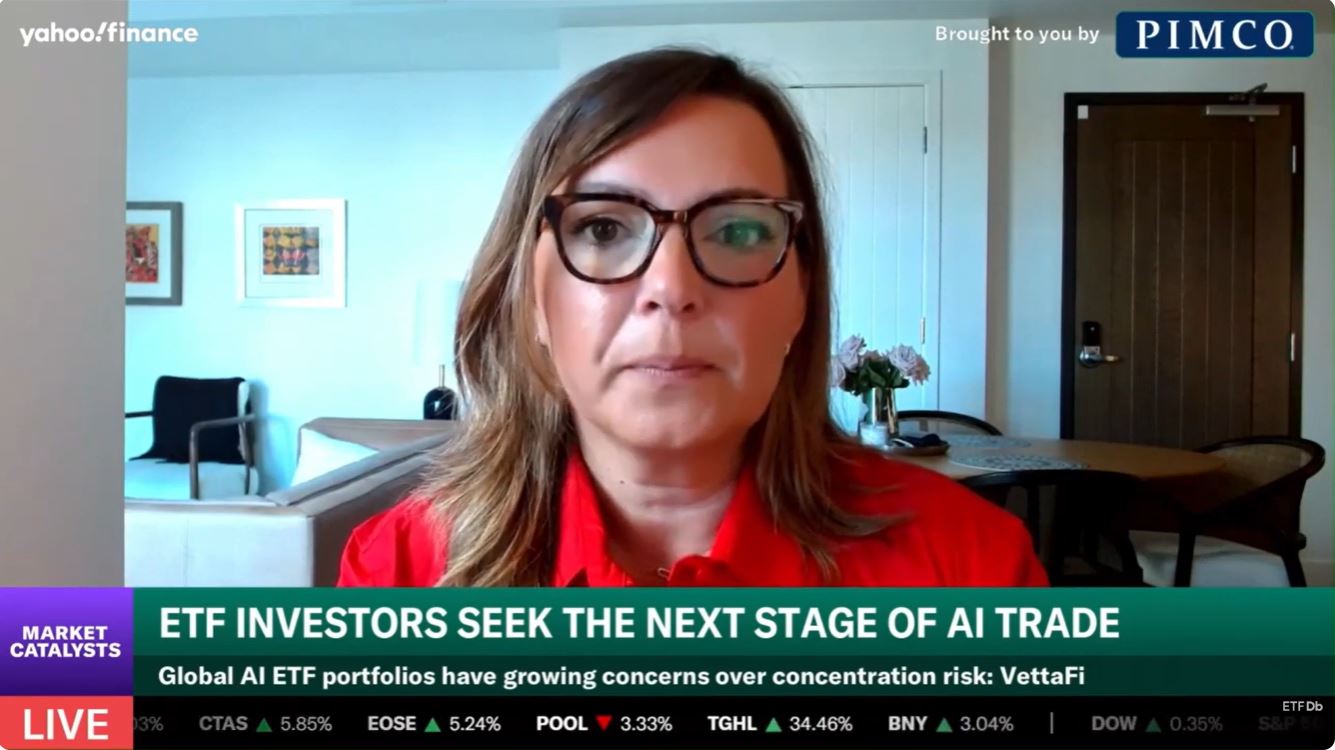
The rapid proliferation of artificial intelligence has fundamentally altered the investment landscape, transforming from a speculative niche into the primary engine of global equity market growth. As investors grapple with the inherent volatility of "AI mania," the strategy of picking individual winners has become increasingly perilous. In a recent appearance on Yahoo! Finance, Cinthia Murphy, Director of Research at VettaFi, addressed this volatility, advocating for a holistic investment approach: capturing the entire AI value chain rather than gambling on single-stock performance.
At the center of this discussion is the ROBO Global Artificial Intelligence ETF (THNQ), a fund designed to provide broad-spectrum exposure to the technologies powering the AI revolution. By moving beyond the "mega-cap" narrative, investors are increasingly looking for ways to mitigate single-stock risk while still capturing the upside of a technology that is reshaping global infrastructure.
Main Facts: The Shift Toward Holistic AI Exposure
The central thesis presented by Murphy is that the "AI winner-take-all" mentality is a strategic error for the average investor. In a market where a single company might lead the headlines one day and face a sharp correction the next, the volatility associated with concentrated AI bets is often too high for long-term portfolio stability.
The ROBO Global Artificial Intelligence ETF (THNQ) functions as a strategic response to this environment. Unlike concentrated funds that focus solely on GPU manufacturers or software giants, THNQ tracks the ROBO Global Artificial Intelligence Index. This index is specifically constructed to capture companies that derive a significant, measurable portion of their revenue from AI, ensuring that the fund is not merely a collection of tech stocks, but a targeted basket of AI-native innovators.
Key to this strategy is the "THNQ score," a proprietary quantitative metric that evaluates a company’s commitment to AI. This score factors in R&D expenditure, AI-related revenue, and overall leadership within the industry. By requiring a minimum score of 50 for inclusion, the fund ensures that its constituents are not just "AI-adjacent" but are active, primary participants in the development and deployment of intelligence technologies.
Chronology: The Evolution of AI Investing
To understand the current state of the AI ETF market, one must look at the progression of technology adoption over the last several years:
- 2020–2021: The Early Adoption Phase. AI was viewed primarily through the lens of data science and enterprise automation. Investments were focused on large-scale cloud providers and early-stage infrastructure.
- 2022–2023: The Generative AI Inflection Point. The public release of advanced Large Language Models (LLMs) shifted the market’s focus toward compute capacity. This period saw a massive rotation into hardware and semiconductor companies, leading to the current "mega-cap" dominance.
- 2024: The Infrastructure and Integration Era. As the market matures, investors are beginning to recognize that AI is not just a hardware story. The current phase is characterized by the integration of AI into cybersecurity, enterprise software, data platforms, and edge computing.
Murphy’s commentary reflects this shift. The market has moved past the initial shock of AI’s potential and is now in the "implementation" phase, where the breadth of the AI value chain—from physical hardware to complex software layers—is becoming the primary driver of value.
Supporting Data: Why the Value Chain Matters
The AI value chain is complex and stratified. It is not sufficient to simply invest in the providers of chips; one must also account for the companies that build the data centers, those that provide the cybersecurity necessary for AI-driven networks, and the companies deploying AI in practical, real-world scenarios.
The Breakdown of the Value Chain
According to the methodology behind THNQ, a comprehensive AI portfolio must include:
- Hardware and Infrastructure: The foundation of AI. This includes semiconductor manufacturers, specialized chip designers, and data center real estate.
- Data Platforms: Companies that curate, clean, and manage the massive datasets required to train AI models.
- Software and Applications: The layer that connects AI to the end-user. This includes SaaS companies integrating predictive analytics and generative AI into existing business workflows.
- Cybersecurity: As AI increases the attack surface for enterprises, companies providing AI-driven threat detection have become essential to the AI ecosystem.
- Adopters: Companies that are successfully integrating AI to drive operational efficiency and revenue growth in traditional sectors like healthcare, finance, and manufacturing.
By diversifying across these segments, THNQ minimizes the "single-stock risk" inherent in the AI sector. When the hardware cycle cools, the software cycle may accelerate; when cybersecurity demands spike, the infrastructure providers benefit. This internal hedging is the primary benefit of the value-chain approach.
Official Responses and Strategic Rationale
"There’s a lot of funds in these categories, and we’ve seen all of them find assets, find traction, as folks try to diversify that single stock risk," Murphy stated during the interview. Her comments underscore a broader trend within the investment advisory community: a pivot toward risk-adjusted returns.
The rationale for the THNQ weighting methodology is rooted in objectivity. By utilizing the THNQ score, the index removes human bias from the selection process. A company cannot simply "brand" itself as an AI firm to be included; it must demonstrate its commitment through R&D investment and actual revenue generation. Furthermore, the market cap requirement of $200 million and the liquidity requirement of $1 million in average daily volume ensure that the fund remains investable and avoids the pitfalls of micro-cap volatility.
This structured approach provides a level of professional rigor that individual investors often lack. By relying on a transparent, rules-based index, investors gain exposure to a global, pure-play basket of companies that are actively building the future, rather than companies that are simply riding the market hype cycle.
Implications: The Future of AI Portfolios
What does this mean for the future of investor portfolios? The implications are three-fold:
1. The Death of the "Single-Stock" AI Strategy
The era of relying on one or two dominant tech companies to carry the entire weight of a portfolio’s AI exposure is likely coming to an end. As regulators and market cycles test these giants, the inherent volatility will drive more capital into diversified, value-chain-focused ETFs.
2. The Rise of "Pure-Play" Requirements
Investors are becoming more sophisticated. They are beginning to demand that "AI funds" actually contain AI companies. Products that rely on broad market indices—which often include companies with negligible AI exposure—will likely lose ground to funds like THNQ that enforce strict revenue and R&D-based inclusion criteria.
3. Global Perspective
AI is not a localized phenomenon. While much of the initial hype was centered on US-based mega-caps, the global value chain includes innovators in Taiwan, South Korea, Japan, and Europe. An effective AI ETF must be globally diverse to capture the innovations occurring across international borders.
Conclusion
As we look toward the next decade, the narrative surrounding AI will shift from "the hype" to "the integration." Investors who continue to chase individual stocks will likely be subjected to extreme bouts of volatility that can erode long-term gains. Conversely, those who adopt a value-chain approach—gaining exposure to the entire spectrum of infrastructure, software, and adoption—will be better positioned to benefit from the systemic growth of the technology.
The ROBO Global Artificial Intelligence ETF (THNQ) serves as a prime example of how modern financial products are evolving to meet these challenges. By prioritizing data-driven metrics, strict inclusion criteria, and broad-based exposure, it provides a blueprint for how to invest in the most transformative technology of our lifetime.
As Murphy noted, the goal is not to predict the winner of a single race, but to own the entire stadium in which the race is taking place. In the complex, fast-moving world of artificial intelligence, that shift in perspective is the key to sustainable, long-term success.
Disclaimer: VettaFi is the index provider for THNQ for which it receives an index licensing fee. However, THNQ is not issued, sponsored, endorsed, or sold by VettaFi, and VettaFi has no obligation or liability in connection with the issuance, administration, marketing, or trading of THNQ. All investments involve risk, including the loss of principal. Please consult with a financial advisor before making any investment decisions.