Beyond the Ledger: Why Reparations and Racial Repair are the Future of American Democracy
In 2021, a profound historical pivot occurred in Manhattan Beach, California. Nearly a century after local government officials seized a thriving beachfront resort from Willa and Charles Bruce—a Black couple targeted by neighbors explicitly motivated by racial animus—the property was returned to their descendants. The move was more than a transfer of title; it was a rare, high-profile acknowledgment of a systemic theft that had robbed generations of the Bruce family of their rightful economic inheritance.

"It is never too late to right a wrong," Janice Hahn, chair of the Los Angeles County Board of Supervisors, remarked at the time. Yet, the story of Bruce’s Beach serves as a microcosm for a much larger, unresolved American narrative. Today, the racial wealth gap in the United States remains a chasm so wide that, should the wealth of white households remain stagnant, it would take Black families approximately 228 years to achieve parity. This is not a matter of individual failure; it is the predictable outcome of "hard histories"—a century-spanning pattern of race-based policies, from the National Housing Act to the GI Bill, that have systematically funneled wealth into white communities while extracting it from Black ones.

The Architecture of Inequity: A Chronology of Policy
To understand the necessity of reparations, one must first confront the deliberate design of American economic inequality. The wealth gap is not accidental; it is the result of government-sanctioned policy frameworks.
- 1783: Belinda Sutton, a formerly enslaved woman in Massachusetts, petitions the state legislature for a pension from the estate of her former enslaver, marking one of the earliest documented demands for reparations.
- 1862: While later eras would reject the concept of reparations for the formerly enslaved, President Abraham Lincoln signs the District of Columbia Emancipation Act, which notably provided financial compensation—to slaveholders, not the enslaved—for every person freed.
- 1865: The unfulfilled promise of "40 acres and a mule" becomes the symbolic bedrock for future reparations discourse.
- 1930s–1950s: The implementation of the National Housing Act and the rise of redlining systematically exclude Black families from the suburban wealth-building boom. Simultaneously, the GI Bill, while transformative for millions of white veterans, effectively bars Black veterans from the same benefits, exacerbating the generational wealth divide.
- 1988: The Civil Liberties Act sees the U.S. government issue a formal apology and $1.6 billion in reparations to survivors of Japanese American internment camps, establishing a precedent for state-led redress.
- 2021–Present: The return of Bruce’s Beach and the implementation of housing-based reparations in Evanston, Illinois, signal a new, localized era of reparatory action.
The Economic Case: Data as Evidence
The racial wealth gap currently stands at an estimated $11.2 trillion. Economists and researchers emphasize that this is a drag on the entire national economy. Closing this gap would, according to various projections, add between $1 trillion and $1.5 trillion in GDP to the U.S. economy annually.
By 2050, the elimination of racial disparities in health, incarceration, and employment could net the nation an additional $8 trillion in GDP. Currently, there is a $330 billion disparity in annual wealth flow between white and Black families, driven largely by intergenerational transfers. As the United States enters the largest wealth transfer in its history—with an estimated $84 trillion passing from the baby boomer generation to their heirs over the next two decades—philanthropic and government leaders have a unique window to decide whether this transfer will continue to calcify existing inequities or serve as a catalyst for a more balanced economic future.

Defining the Movement: Restitution and Repair
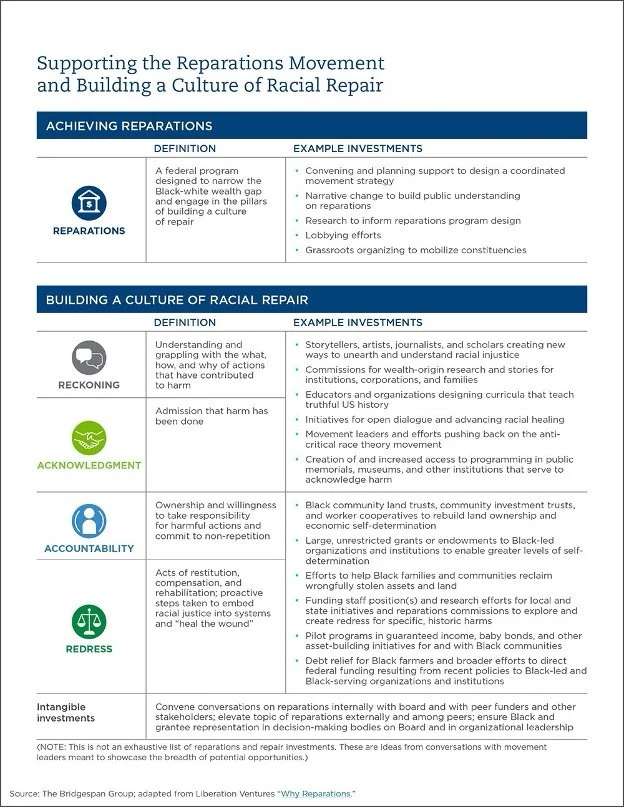
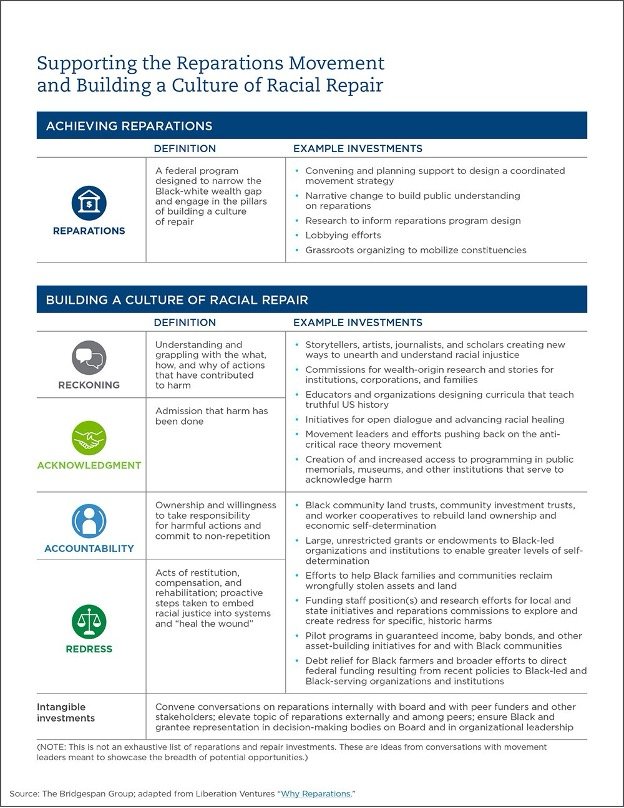
A major hurdle in the modern reparations movement is the misconception that the term refers exclusively to a "check." Experts define reparations through a more comprehensive, internationally recognized legal framework, which includes:

- Restitution: Restoring original property or rights (e.g., land return).
- Compensation: Addressing documented financial damage.
- Rehabilitation: Providing access to legal, medical, and psychological care.
- Satisfaction: Public apologies, truth-seeking commissions, and memorials.
- Guarantees of Non-repetition: Structural policy changes to prevent the recurrence of harm.
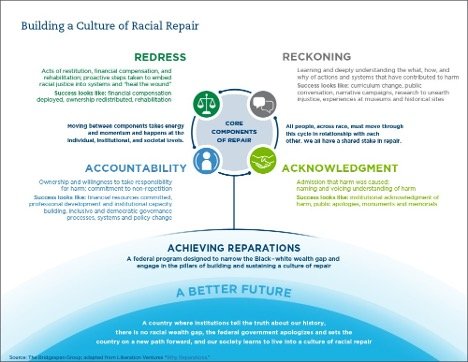
Building a "culture of repair" is the essential, often overlooked, corollary to these payments. It involves cultivating the social and political norms necessary to acknowledge past harms and implement long-term structural changes. As Edgar Villanueva, founder of the Decolonizing Wealth Project, notes: "When we work to repair as a nation… we are all going to benefit tremendously."
Official Responses and Political Resistance
The movement for reparations has found itself in a complex political crossfire. While organizations like the National Coalition of Blacks for Reparations in America (N’COBRA) have advocated for decades, the mainstreaming of the conversation has invited significant backlash. The rise of anti-critical race theory legislation, with over 500 measures introduced in 2021 and 2022, represents a well-funded effort to sanitize the teaching of American history and stifle discussions about systemic repair.

Despite this, the momentum is undeniable. In 2022, the United Nations formally called on the U.S. government to initiate a process of reparations. Representative Cori Bush’s 2023 introduction of the "Reparations Now Resolution" continues a legislative tradition that, while stalled, keeps the issue at the forefront of the national agenda. Philanthropy has also begun to shift; foundations such as the Ford, MacArthur, and Hewlett funds are increasingly supporting the infrastructure of the reparations ecosystem, recognizing that "doing nothing" is a choice that carries its own set of costs.

Implications: A Vision for a Post-Reparations America
The vision for a nation that has undergone the process of racial repair is one of profound liberation. Leaders in the movement describe a future where Black identity is no longer contested, where the "predictable outcomes" of race—in health, wealth, and justice—are severed.

"On the other side of this," says Ricshawn Adkins Roane of the Weissberg Foundation, "is true liberation. It’s the ability to exist in our fullness."
For the broader American populace, the implications are equally transformative. If the "protocols of anti-Blackness" have indeed become the "protocols of oppression" for the entire nation, then the dismantling of these systems benefits everyone. A country that no longer needs to spend trillions on the maintenance of inequality, incarceration, and the suppression of potential is a country capable of redirecting its genius toward innovation, community health, and genuine, multiracial democracy.

As attorney and activist Nkechi Taifa emphasizes, the question is no longer if this conversation will reach the mainstream, but how the nation will choose to engage with it. The movement for reparations is not merely a request for compensation for the past; it is a forward-looking investment in the viability of the American experiment. By confronting the "hard history" of the last four centuries, the United States has the opportunity to build a foundation that is, for the first time, truly equitable—not just for some, but for all who call it home.