The Great Pivot: How AI and Change Management are Redefining the Accounting Profession
The accounting landscape is undergoing a seismic shift. For decades, the profession was defined by rigid adherence to regulatory cycles, manual data reconciliation, and the steady accumulation of billable hours. Today, those foundations are being reshaped by a singular, overwhelming force: the rapid integration of artificial intelligence (AI) and the complex change management strategies required to harness it.
According to the latest CPA Firm Top Issues Survey conducted by the AICPA’s Private Companies Practice Section (PCPS), change management related to technology—specifically the rise of AI—has officially vaulted to the top of the list of concerns for accounting firms. As firms look toward the next five years, the ability to adapt to these technological advancements is no longer a competitive advantage; it is a fundamental requirement for survival.
Main Facts: The New Hierarchy of Priorities
The 2024 survey, which garnered insights from 629 participants between April 20 and May 22, reveals a stark departure from the priorities identified just two years ago. In the 2022 iteration of the survey, technology-related issues were relegated to the lower tiers of importance, appearing primarily among the smallest and largest firm groups.
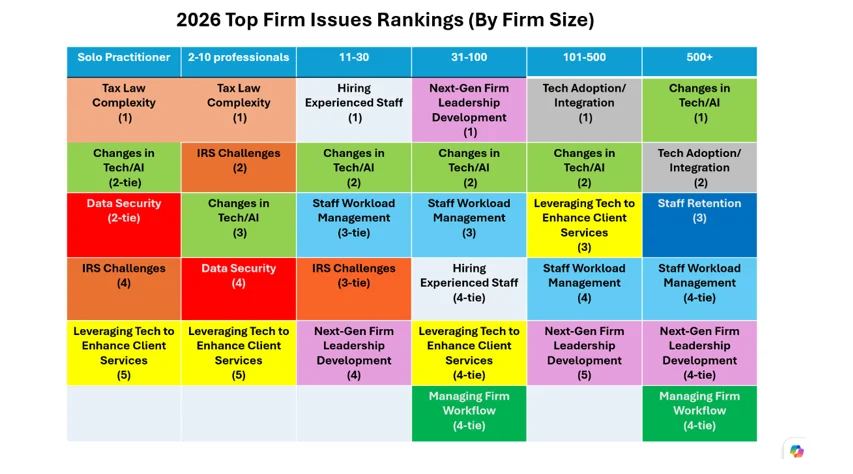
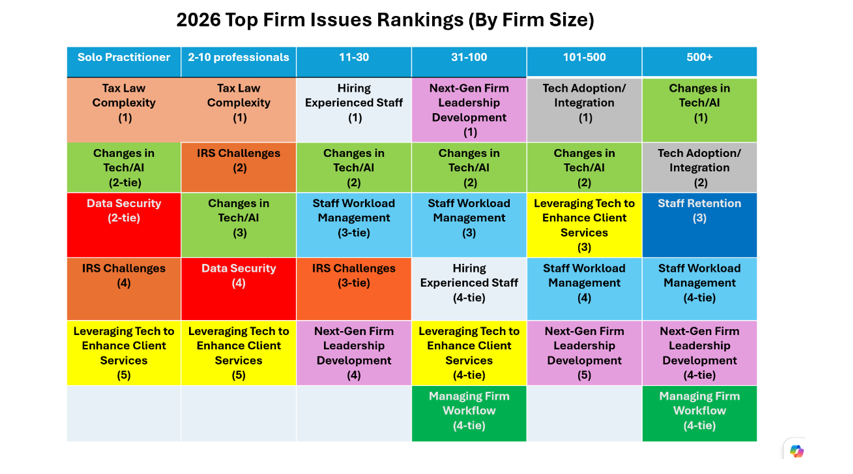
In the current data, the narrative has flipped. AI and technology adoption now dominate the top two spots for the largest firms—those with more than 100 employees. For firms with 101 to 500 employees, technology adoption and integration lead the list, followed closely by the broader challenges of managing AI-driven change. Among the largest firms (those with more than 500 staff), these two priorities are simply reversed, underscoring that for the industry’s heavyweights, the transition to a tech-first operating model is the primary strategic imperative.
However, the survey also highlights that "one size fits all" is a dangerous assumption in the accounting world. While AI is a universal concern, the day-to-day pressures shift significantly depending on a firm’s scale:
- Solo Practitioners and Small Firms (up to 10 employees): Tax law complexity remains the dominant hurdle, reflecting the immense administrative burden placed on boutique operators.
- Midsize Firms (11–30 employees): The battle for talent remains the primary obstacle, with the recruitment of experienced staff ranking as the number one concern.
- Growth-Stage Firms (31–100 employees): The focus shifts to long-term sustainability, with the development of next-generation leadership taking the top spot.
Chronology: A Rapid Evolution of Concerns
To understand the current urgency, one must look at the trajectory of the profession over the last 24 months.
2022: The Talent Crunch. Two years ago, the profession was reeling from the post-pandemic labor market. The primary concern across almost all firm sizes was finding qualified staff. The "Great Resignation" and the subsequent difficulty in attracting talent created a bottleneck that forced firms to prioritize headcount over technological innovation.
2023: The AI Awakening. The public release of generative AI tools in late 2022 and throughout 2023 acted as a catalyst. Accounting firms, which handle massive volumes of structured data, realized that their traditional service models—tax prep, audit, and bookkeeping—were prime candidates for AI-driven automation.
2024: The Integration Crisis. By the time the current survey was conducted, the novelty of AI had worn off, replaced by the daunting reality of implementation. Firms are no longer asking if they should use AI; they are asking how to integrate it without disrupting their quality management systems or alienating their workforce. The current data reflects a profession transitioning from curiosity to the "hard work" phase of digital transformation.
Supporting Data: The Impact of Scale
The AICPA survey utilizes a 1-to-5 scale (1 being "minimal" and 5 being "extreme") to gauge the expected impact of these issues over the next five years. The data suggests that while larger firms are laser-focused on technology, smaller firms are operating under a more fragmented set of pressures.
For firms with 11 to 100 employees, "staff workload management" has emerged as a top-four concern. This is a critical indicator: it suggests that while firms are trying to implement new technologies, they are also struggling to balance those transitions against the high-pressure, high-volume requirements of tax and audit seasons.
Furthermore, the data shows that "data security" and "IRS challenges" remain perennial stressors for the smaller firms. While a firm with 500+ employees might have a dedicated cybersecurity department, the solo practitioner or the small partnership is often the sole line of defense against increasing cyber threats, explaining why these issues remain perennially high in their rankings.
Official Responses: The Human Element of Technology
Lisa Simpson, CPA, CGMA, and vice president of Firm Services at the AICPA, emphasizes that the survey results represent more than just a shift in software; they represent a fundamental change in the "people side" of accounting.
"The top issues for firms tie into the transformation we’re seeing in technology, people skills, and operating models," Simpson noted in the survey release. Her perspective highlights a critical nuance: technology is only as effective as the human beings who wield it.
"We know keeping up with rapid developments in AI and technology capabilities can be a challenge, but the survey also revealed that there are challenges with integrating technology and leveraging it to enhance service offerings," Simpson added. This suggests that the industry is currently in a "valley of death" between acquiring new tools and actually realizing value from them.
Simpson’s remarks also touched on the shifting requirements for the modern CPA. As AI takes over rote tasks, the value proposition of the accountant shifts toward advisory, strategy, and complex problem-solving. "On the people side, we’re seeing more focus on reframing job skills, managing staff workload, developing leaders, and evolving services to meet client expectations. Regardless of technology capabilities, accounting is still a people business."
Implications: The Road Ahead
The implications for the profession are profound. As we look at the next five years, several key trends emerge from the survey’s findings:
1. The Death of the Generalist?
As AI tools become more sophisticated, the "generalist" accountant may struggle to compete. Firms that invest in AI are shifting their focus toward specialized, high-value advisory services. This implies that the next generation of CPAs will need to be part-data scientist, part-consultant, and part-strategist.
2. The Leadership Gap
With "next-gen firm leadership development" ranking as a top concern for firms with 31–100 employees, there is a clear anxiety regarding the pipeline of future partners. As the nature of the work changes, the skills required to lead an accounting firm are also changing. Developing leaders who can guide a firm through a digital transformation—while maintaining a healthy, sustainable culture—will be the defining challenge for managing partners.
3. Quality Management (QM) as a Competitive Edge
The fact that "bolstering quality management systems" made the top five in four of the six firm groups is telling. As AI assumes more responsibility for financial reporting and data processing, the risk of "hallucinations" or errors in automated systems becomes a liability. Firms that can build robust, AI-resistant quality controls will likely command a premium in the marketplace.
4. A New Definition of "Staffing"
The focus on "job skill shifts" suggests that firms are moving away from traditional hiring models. Instead of simply looking for more hands to handle the workload, firms are looking for individuals capable of managing automated systems. This will inevitably lead to a change in the educational requirements for new entrants into the profession, placing a greater emphasis on technology literacy and analytical thinking.
Conclusion: Adapting or Obsolescing
The 2024 AICPA survey paints a portrait of an industry in the middle of a delicate balancing act. Accounting firms are attempting to build the "firm of the future" while simultaneously managing the pressures of the present.
For the solo practitioner, the challenge is maintaining excellence amidst an ever-changing tax code and a mounting threat of cyberattacks. For the large firm, the challenge is one of scale: how to integrate AI across hundreds of employees without losing the personal touch and professional rigor that defines the CPA brand.
Ultimately, the data confirms that technology is the catalyst, but people remain the engine. As firms move forward into the next five years, success will likely be determined not by who has the most sophisticated AI tools, but by who can most effectively navigate the human change management required to make those tools meaningful. The "people business" of accounting is not disappearing; it is simply upgrading.