The Stalled Sovereign: Why Bosnia’s Dependency Trap Must End
By Carl Bildt
June 19, 2026
STOCKHOLM — More than three decades after the ink dried on the Dayton Accords—the fragile peace agreement that silenced the guns of the 1992-95 Bosnian War—the nation of Bosnia and Herzegovina remains suspended in a state of political limbo. While the world has moved forward, Bosnia remains a ward of the international community, trapped in a cycle of institutional paralysis and external intervention.
The recent intervention by the Trump administration in Bosnian internal affairs, widely perceived by regional observers as both opaque and arguably corrupt, presented a theoretical opening to break this deadlock. It could have been the catalyst for a genuine transition toward full, unencumbered sovereignty. Instead, the move has reinforced the very structures of dependence that have stifled the country’s progress since the mid-1990s. As it stands, the vicious cycle of international oversight and local inaction is set to continue, threatening the long-term stability of the Western Balkans.
The Core Conflict: A Sovereignty Deficit
At the heart of the crisis is a fundamental misalignment between the Dayton-era governance structures and the requirements of a modern, functioning European state. The current constitutional framework, designed primarily as a mechanism to end hostilities rather than to facilitate efficient governance, has become a straitjacket.
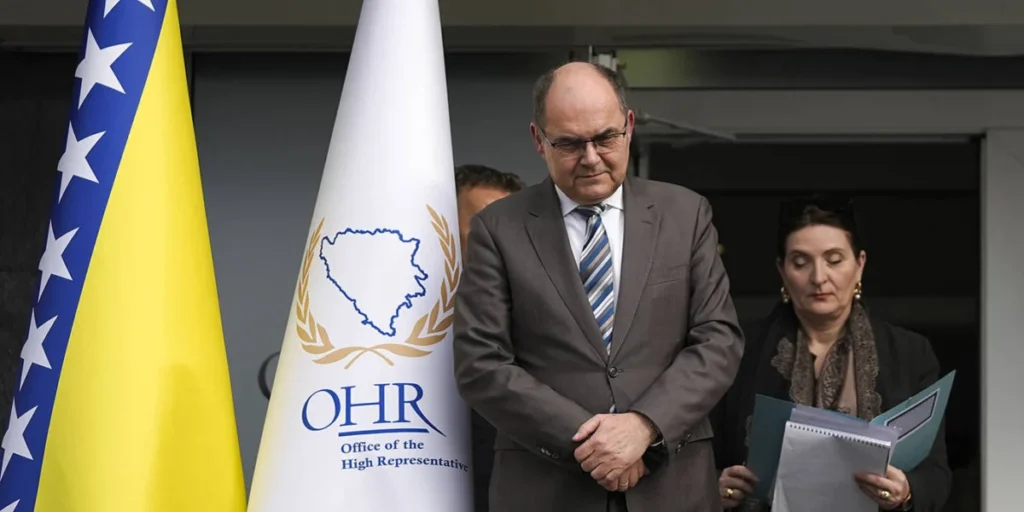
The Office of the High Representative (OHR), created to oversee the civilian implementation of the peace agreement, holds sweeping "Bonn Powers." These allow the High Representative to impose legislation and remove elected officials from office. While these powers were essential in the immediate aftermath of the war, their continued application in 2026 undermines the democratic agency of the Bosnian people. When external actors intervene—whether they are from Brussels, Washington, or elsewhere—the incentive for local politicians to reach difficult compromises evaporates. Why negotiate with a political rival when you can lobby an international patron to impose your will?
Chronology of Stagnation: From Dayton to the Present
To understand the current impasse, one must trace the timeline of Bosnia’s fragile evolution:
- 1995: The Dayton Accords. Signed in December 1995, the agreement established a complex, decentralized state consisting of two entities: the Federation of Bosnia and Herzegovina and the Republika Srpska.
- 1996–2005: The Reconstruction Era. International intervention was characterized by robust economic aid and the active role of the OHR in drafting the foundational laws of the new state.
- 2006–2015: The Decade of Drift. Attempts to reform the constitution (the "April Package") failed by a single vote. The international community began to shift its focus from "nation-building" to "EU integration," though progress remained glacial.
- 2016–2024: The Rise of Ethno-Nationalism. Political discourse retreated into hardline ethnic narratives. The OHR began utilizing the Bonn Powers more frequently to bypass parliamentary gridlock, ironically deepening the resentment of domestic actors.
- June 2026: The Trump Intervention. A sudden, high-level maneuver by the current U.S. administration, involving back-channel negotiations with regional power brokers, effectively circumvented established diplomatic protocols, leading to the latest wave of controversy.
Supporting Data: The Cost of Indecision
The human and economic cost of this ongoing dependency is staggering. Data from the World Bank and various NGO monitors paint a bleak picture of a nation hemorrhaging its most valuable resource: its people.
- Brain Drain: Since 2015, it is estimated that over 300,000 citizens—primarily the youth and highly educated professionals—have emigrated to the European Union. This demographic collapse is the direct result of a lack of faith in the domestic political system.
- Economic Stagnation: Bosnia’s GDP growth consistently lags behind its neighbors in the Western Balkans. Corruption indices consistently rank the country in the bottom tier of European nations, as the lack of political accountability fosters a patronage economy.
- Governance Efficiency: The "Dayton bureaucracy"—a system of triple-layered government (state, entity, and cantonal)—has created one of the highest public-sector-to-private-sector ratios in the world, stifling entrepreneurial growth and creating a bloated, ineffective civil service.
Official Responses and Diplomatic Fallout
The reaction to the latest U.S. intervention has been deeply polarized. Supporters of the administration’s actions claim that "bold, pragmatic diplomacy" is necessary to prevent the secessionist rhetoric emanating from the Republika Srpska. They argue that the international community cannot afford to wait for consensus in a room where parties refuse to speak to one another.
However, the critics—ranging from local civil society leaders to European diplomatic veterans—argue that the intervention is a textbook example of "transactional politics." By dealing with individuals rather than institutions, the U.S. has undermined the rule of law.
"This is not diplomacy; this is the management of a client state," noted one senior EU envoy on the condition of anonymity. The European Commission has expressed "grave concern" regarding the lack of transparency, signaling a growing rift between Washington’s current approach and Brussels’ emphasis on long-term institutional capacity building.
Implications: A Path Forward or a Downward Spiral?
The implications of this trajectory are profound. If Bosnia remains a ward of the international community, it will never develop the "political muscle" required to handle its own domestic crises.
The Necessity of a Political Reboot
A genuine reboot must include three critical components:
- Phase-Out of the OHR: There must be a clear, non-negotiable timeline for the closure of the Office of the High Representative. Continued existence of the OHR acts as a safety net that encourages political irresponsibility.
- Constitutional Revision: The Dayton structure must be modernized to prioritize functionality over ethnic quotas. This is not to suggest the abandonment of minority protections, but rather the implementation of a system that allows for majority rule in legislative matters.
- Localized Accountability: The international community must stop acting as a mediator for every minor political dispute. By forcing the political elite to sit at the table—and keeping them there until a solution is found—the international community can shift the burden of responsibility back to those who were elected to lead.
The Regional Risk
The failure to resolve the Bosnian question does not occur in a vacuum. As the Western Balkans look toward EU accession, a dysfunctional Bosnia acts as an anchor on the entire region. It provides a playground for external malign influences, including those seeking to destabilize the European project by exploiting internal ethnic grievances.
Conclusion: The Burden of Freedom
The history of the last 30 years shows that foreign intervention is a diminishing asset. The more it is used, the less effective it becomes. Bosnia and Herzegovina is at a crossroads. It can either continue to be a country that is "managed" by outsiders, or it can take the difficult, painful, and necessary steps toward true self-governance.
The Trump administration’s intervention may have been motivated by a desire for a quick fix, but there are no quick fixes in a country built on the ashes of conflict. True stability can only be achieved when the people of Bosnia are permitted to own their future—including the right to fail, the right to succeed, and the duty to hold their own leaders accountable.
Thirty years of peace is an achievement, but peace is not the same as progress. It is time to move beyond the structures of 1995 and allow Bosnia to finally grow into its own sovereignty. The alternative is a slow, agonizing slide into irrelevance, where the international community remains a spectator to a nation’s gradual disappearance.