The Infrastructure of Democracy: Why Voter Registration Must Move Beyond Partisan "Charity"

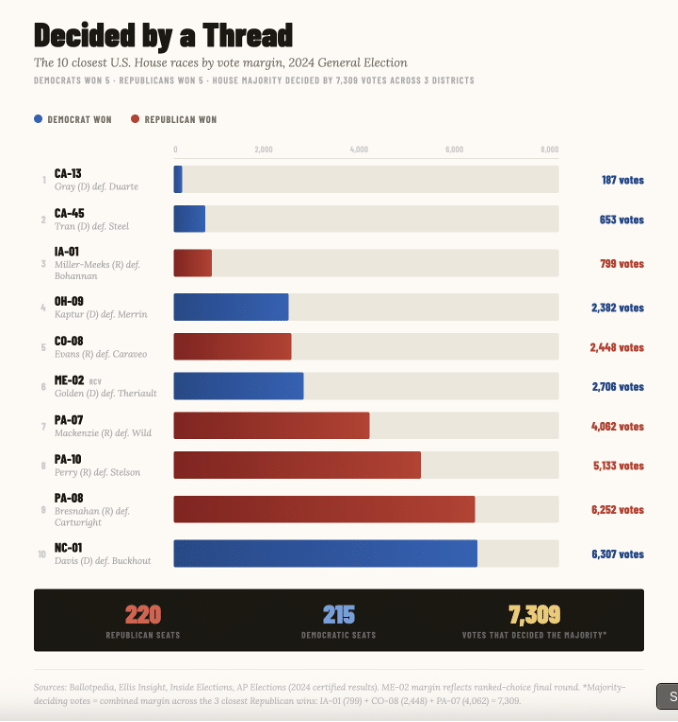
In the landscape of American politics, the margin between victory and defeat is often measured in paper-thin increments. In 2024, the United States witnessed one of the most consequential displays of this reality in California’s 13th Congressional District. In a race where over 210,000 ballots were cast, the outcome was decided by a staggering 187 votes—a margin representing less than one-tenth of one percent of the total electorate.
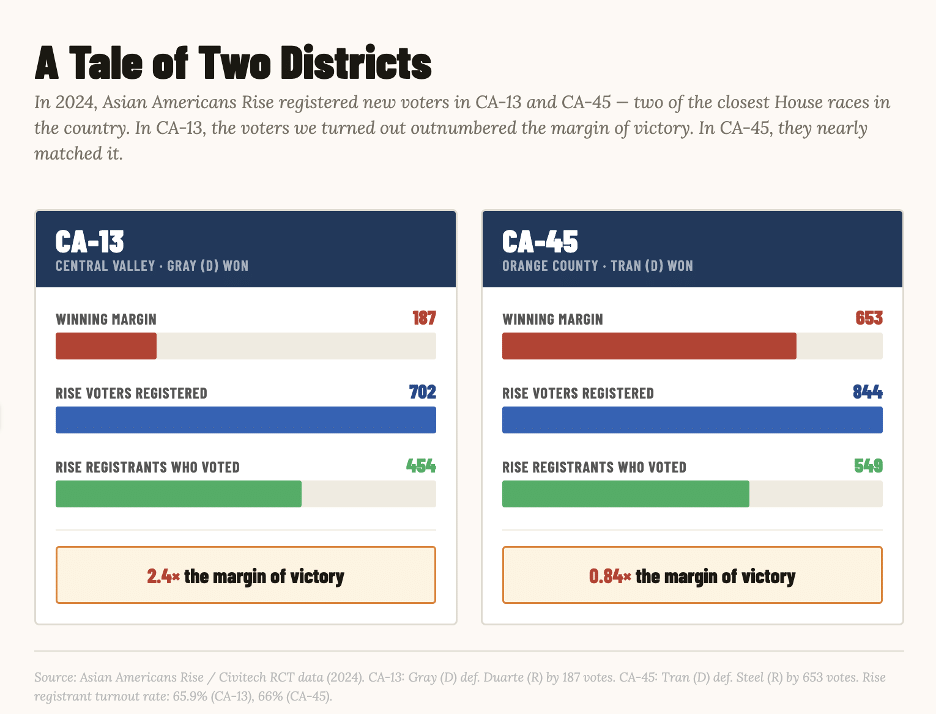
For the organizers at Asian Americans Rise, that number was not just a statistic; it was a call to action. Earlier that year, the organization had launched a targeted voter registration effort in the district, successfully registering 702 new voters. Of those, 454 turned out to cast their ballots. In a race decided by 187 votes, a single, modestly funded initiative had effectively produced more than twice the margin of victory.
This story is not an outlier; it is a symptom of a broader, systemic deficiency. When thirteen U.S. House races in 2024 were decided by fewer than 8,000 votes each, and the entire control of the House of Representatives hinged on a combined margin of just 7,309 votes across three pivotal seats, it becomes clear that American democracy is not being won by the most compelling platform, but by the most effective logistical operation.
The Myth of Apathy: A Convenient Political Narrative
For decades, the political establishment has relied on a comfortable, albeit misleading, explanation for low voter turnout: apathy. We are told that people do not vote because they are disengaged, disinterested, or simply do not care about the direction of the country.

However, evidence from the front lines of community organizing suggests that "apathy" is a convenient lie used to mask a fundamental failure of infrastructure. In our experience, non-voters are not people who have rejected the democratic process; they are people whom the system has failed to reach. They are citizens who were never prompted at the DMV, never contacted in a language they speak, and never provided with a credible reason to believe that their individual ballot would carry weight until the window to register had already closed.
Voter registration in the United States was never built to function at a national, high-volume scale. Historically, the system was designed as a gatekeeper—an exclusionary mechanism meant to filter who could participate. Today, that legacy persists as a fragmented, dysfunctional ecosystem characterized by high turnover, a lack of institutional memory, and a reliance on reactive, last-minute campaigning rather than proactive, year-round engagement. We treat the machinery of democracy with a level of neglect we would never tolerate in disaster relief or public utility management. We do not rebuild the power grid every time a storm approaches; yet, we treat voter infrastructure as a temporary, "pop-up" effort that dissolves the moment the polls close.
Chronology of a Failed Model
To understand the current crisis, one must look at the historical progression of American voter engagement. For most of the 20th century, voter registration was a decentralized, local affair. As partisan polarization increased in the 21st century, registration became a tool of political warfare rather than a public service.
- Pre-2000s: Voter registration was largely handled by local boards of elections and civic groups. It was static and often relied on physical paper applications processed through mail or in-person visits.
- The 2010s: The rise of Big Data allowed political parties to surgically target potential voters. While this increased efficiency for party-aligned candidates, it deepened the "registration gap" for communities that did not align perfectly with existing partisan databases or who lived in "safe" districts.
- 2020-2024: The pandemic and subsequent political instability forced a reckoning. Organizations like Asian Americans Rise recognized that the traditional model—wait until the election is weeks away and then scramble to register voters—was mathematically insufficient.
The 2024 cycle demonstrated that the "scramble" model is obsolete. The organizations that succeeded were those that moved away from the "get-out-the-vote" (GOTV) fire drill and toward a "registration-first" infrastructure model.

Supporting Data: The Case of the Toss-Up Districts
In 2024, Asian Americans Rise targeted 12 toss-up congressional districts characterized by large, historically under-registered Asian American populations. The strategy was deliberate: rather than treating registration and turnout as two distinct, disconnected events, they built a single, continuous system.
Using advanced voter-file analysis and demographic modeling, the organization identified eligible, unregistered individuals months before the registration deadlines. They implemented a system of direct mail and follow-up text messaging tailored to the specific linguistic and regulatory needs of each district.
The data from the California districts is instructive:
- CA-13: 702 voters registered; 454 voted. The race was decided by 187.
- CA-45: 844 voters registered; 549 voted. The race was decided by 653.
In both instances, the registration effort did not just "influence" the race; it effectively functioned as the margin of victory. The lesson is unequivocal: when outreach is early, consistent, and culturally competent, voters do not exhibit apathy—they exhibit agency.
The Structural Barrier: Why This Isn’t Universal
If the solution is so simple, why is it not the national standard? The answer lies in the current political economy of elections. Currently, voter registration is almost entirely delegated to state political parties. These parties are subject to extreme volatility, high staff turnover, and funding cycles that are tied to specific election years rather than long-term civic health.
Most political operations lack the technical infrastructure to run mass, year-round registration programs. As a result, the "proven" methods of engagement are treated as boutique or niche projects rather than essential infrastructure. This is not a messaging problem. No amount of high-production television advertising or viral social media content can overcome the hurdle of an unregistered voter who has never been invited into the process.
The problem is one of architecture. We are currently trying to run a 21st-century digital democracy using 19th-century administrative plumbing.
Implications: A Call for Infrastructure-Based Democracy
If we are to preserve the integrity and efficacy of our democratic system, we must fundamentally shift our perspective. Voter engagement must be rebranded and reorganized as "civic infrastructure." This requires three distinct shifts:
- From Charity to Public Utility: We must move away from the model of "nonprofit charity" and toward a model of "civic maintenance." This involves creating permanent, non-partisan institutions that are funded to maintain voter rolls, verify eligibility, and conduct outreach regardless of the current electoral cycle.
- Investment in Technical Capacity: The private sector has mastered the art of persistent engagement. The public sector must adopt these data-driven, long-term models to ensure that the electorate is truly representative of the population.
- Institutional Continuity: We must stop disbanding our voter-engagement teams every November. By maintaining a constant, year-round presence, we can build the trust necessary to engage populations that have been historically marginalized by the system.
The Path Forward
The 2024 election cycle proved that the "margin of victory" is not a mystical concept. It is a tangible number that can be reached, understood, and addressed through disciplined, rigorous, and persistent work.
Wendy Nguyen and Andrea Chen, the co-founders of Asian Americans Rise, have argued that we are currently operating in a "Tale of Two Districts" reality. In one, the system is designed to exclude, relying on the hope that voters will be too disengaged to participate. In the other, the system is designed to include, treating every unregistered citizen as a vital component of the democratic fabric.
As we look toward future cycles, the takeaway is clear: democracy is not a spectator sport, nor is it a seasonal event. It is an infrastructure that requires constant, intentional maintenance. If we continue to treat voter registration as a peripheral, short-term task, we will continue to see our most important decisions made by the thinnest of margins. If, however, we choose to treat it as the essential infrastructure of our society, we may finally see a democracy that truly reflects the voice and power of all its people.
The "apathy" of the American voter is a mirror held up to our own failures. It is time we stop blaming the people who aren’t participating and start building a system that makes it possible for them to do so. The future of the House, the Senate, and the very health of our republic depends on whether we are willing to do the unglamorous, necessary work of building a foundation that lasts.