The Future of Urban Transit: Riding the Waves with Vessev’s Electric Hydrofoil
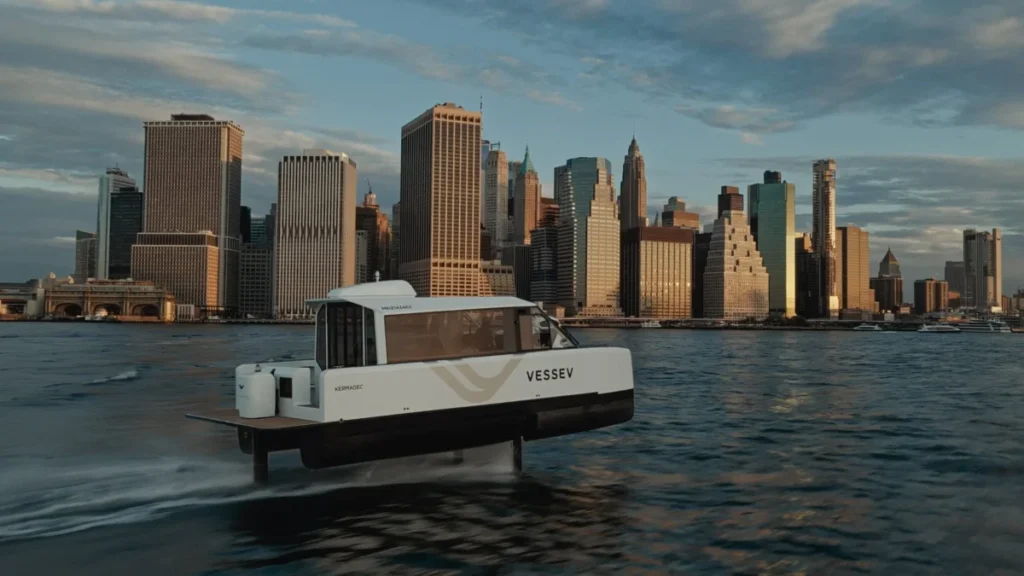
As we pulled away from the Brooklyn Marina, the East River looked like any other day in New York—choppy, bustling with ferry traffic, and decidedly unremarkable. I turned to Eric Laakmann, co-founder and CEO of the maritime startup Vessev, with the question that has been on the minds of urban planners and tech enthusiasts alike: "When will we start flying?"
Laakmann’s answer was disarmingly simple: "We already are."
It was a moment that defied expectation. I had prepared myself for a cinematic, momentous shift—a sudden lift, a hum of turbines, and the sensation of breaking the bonds of gravity. Instead, the VS-9, Vessev’s flagship electric hydrofoil ferry, transitioned with the seamless, quiet grace of a luxury sports car accelerating onto an open highway. It wasn’t a flight in the aeronautical sense, but rather a masterclass in fluid dynamics, transforming a 30-foot vessel from a water-slapping boat into a silent, surface-skimming craft.
The Engineering Behind the "Flight"
To the casual observer, the VS-9 appears to be a standard catamaran, the kind of vessel common in harbor transit. However, beneath the waterline lies a sophisticated, computer-controlled array of wing-like structures. As the vessel gains speed, these foils generate lift, pulling the hull entirely out of the water.
The engineering logic is sound: by eliminating the friction of the hull against the water, the boat drastically reduces drag. This is the "holy grail" of marine transit, especially for electric vessels where every watt-hour of battery capacity is a precious commodity.

"The ride is governed by sensors and active flaps," Laakmann explained as we glided toward Governors Island. "The front foil handles about 80% of the lift, while the rear foil provides the remaining 20%, housing our proprietary electric motor."
By keeping the development of the propulsion system in-house, Vessev has bucked the industry trend of outsourcing critical components. Laakmann believes this is a necessary hedge against future supply chain volatility and a means to maintain cost efficiency as the company scales. While they source batteries—which Laakmann describes as "commoditized" technology—the mechanical heart of the VS-9 is entirely a Vessev creation.
A Brief History of Foiling: From Curiosity to Utility
The concept of hydrofoiling is not new. In fact, inventors have been experimenting with the physics of lifting hulls for over a century. Early prototypes were often temperamental, heavy, or difficult to control in changing sea states.
Historically, hydrofoils were relegated to niche racing circuits or specialized military applications where cost was no object. The challenge for modern innovators like Vessev is to move this technology from the "experimental" category to the "mass-transit" category. This requires not just performance, but reliability, safety, and, most importantly, the ability to operate in real-world urban environments.
The VS-9 manages this by balancing the complexity of the foils with the practicalities of a daily commute. One notable feature is the ability to raise the foils, allowing the boat to dock at standard piers and navigate shallower, more congested waters without risk of damaging the submerged equipment.

Supporting Data: Efficiency and Constraints
The economics of the VS-9 are driven by its efficiency. Traditional vessels lose a significant portion of their energy fighting surface tension and displacement. By hovering above the chop, the VS-9 maintains a consistent speed while consuming a fraction of the energy required by a conventional ferry of similar size.
However, the technology is not without its limitations. Hydrofoils are sensitive to wave height. The VS-9 is designed to "clear" the water by approximately 0.75 meters (roughly 2.5 feet). In conditions where waves exceed this height, the hull begins to slap against the surface, introducing drag and compromising the ride quality.
"It’s not designed for the open ocean," Laakmann admits. "But for lakes, rivers, and protected bays, it’s a game-changer."
The vessel’s current range—40 nautical miles (approx. 46 miles or 74 kilometers)—is more than sufficient for the vast majority of urban ferry routes. Furthermore, the VS-9 is designed to charge using standard EV infrastructure, which significantly lowers the barrier to entry for municipalities looking to integrate these boats into existing transit grids.
Scaling the Vision: $19 Million and Beyond
In August, Vessev secured $19 million in Series A funding, a significant vote of confidence in their vision for sustainable maritime transit. This capital infusion is earmarked for production scaling and operational expansion.

The strategy is twofold:
- Direct Transit Integration: Partnering with city transit authorities to provide a faster, quieter, and more sustainable alternative to current ferry fleets.
- Commercial Partnerships: Targeting the luxury tourism sector, hotels, and private tour operators who value the premium experience of a "flight-like" ride.
Beyond the immediate goal of building more VS-9s, Laakmann is eyeing a broader market disruption. "Eventually, we could see a shift toward producing electric hydrofoil kits," he suggests. By providing the core technology to other shipbuilders, Vessev could catalyze a broader transition in the maritime industry, much like how specialized engine manufacturers transformed the automotive sector in the 20th century.
The Implications for Urban Planning
The potential for cities like New York, San Francisco, or Sydney is immense. These are cities defined by their waterways, yet their ferry systems are often aging, noisy, and carbon-intensive.
The VS-9 represents a "plug-and-play" solution. It requires no new, expensive infrastructure. It uses existing piers, docks at current heights, and charges at standard electrical stations. For urban planners, this is the ideal scenario: a way to increase transit capacity without the multi-billion dollar price tag of tunneling or bridge expansion.
Moreover, the minimal wake produced by a foiling boat is an environmental boon. Traditional ferries churn up the water, causing erosion along shorelines and disturbing aquatic ecosystems. The VS-9 leaves the water behind, creating a minimal footprint that could allow for faster transit speeds in zones where traditional boats are currently forced to operate at "no-wake" idle speeds.

The Verdict: A Quiet Revolution
As the ride concluded, I realized my initial disappointment—the lack of a "momentous" transition—was actually the greatest compliment to the engineering. If the future of mass transit is to be electric, it must be unremarkable in its reliability. We don’t want a "flight" that feels like a stunt; we want a commute that is faster, smoother, and cleaner.
Vessev is not promising to revolutionize the world of aviation or space travel. They are promising to reclaim the water as a viable, efficient, and enjoyable transit corridor. In a world where urban congestion is becoming an existential crisis for major cities, the ability to "fly" over the traffic—or in this case, the waves—might just be the most practical solution available.
As I stepped off the VS-9 and back onto the Brooklyn pier, I didn’t feel like I had just returned from a test flight. I felt like I had just stepped off a regular ferry that had somehow managed to bypass the laws of friction. And in that, there is a quiet, transformative power that could very well reshape the geography of our cities.