Wall Street and Crypto Brace for Impact as the Federal Reserve Weighs Its First Interest Rate Hike Since 2023
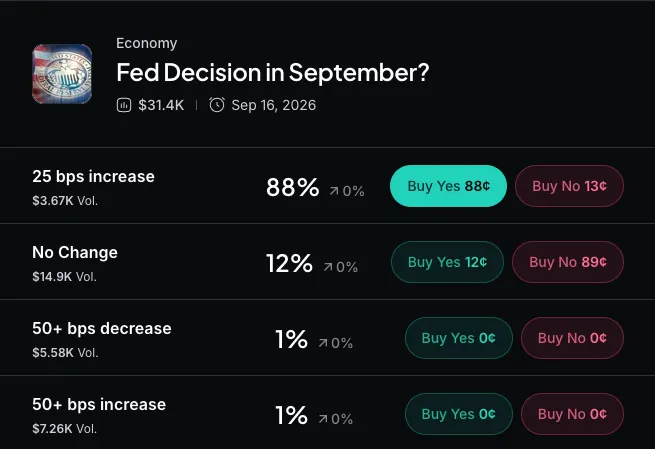
NEW YORK — Financial markets are bracing for a watershed moment this week as the Federal Open Market Committee (FOMC) prepares to wrap up its high-stakes, two-day policy meeting on Wednesday. Wall Street traders, institutional investors, and digital asset markets are positioning themselves for an outcome that once seemed unthinkable just a month ago: an interest rate hike by the U.S. central bank, a policy maneuver the Federal Reserve has not deployed since 2023.
According to CME Group’s widely monitored FedWatch tool, the probability of a quarter-point (25 basis points) interest rate increase sits at a staggering 94.5%. This represents a dramatic and rapid sentiment shift from a month prior, when the likelihood of tightening was priced at under 50%.
The pivot from monetary easing—or even an extended pause—to renewed tightening comes as persistent inflation, geopolitical pressures, and robust employment data collide. For risk-sensitive sectors like equities and digital assets such as Bitcoin, the impending decision threatens to upend liquidity conditions that have supported asset valuations over the past year.
Main Facts
- The Impending Decision: The FOMC will conclude its two-day meeting on Wednesday, with a rate decision and updated economic projections (the "dot plot") scheduled for release at 2:00 p.m. ET, followed by a press conference hosted by Fed Chair Kevin Warsh at 2:30 p.m. ET.
- Soting Market Expectations: CME’s FedWatch tool prices a 94.5% probability of a quarter-point rate hike.
- Institutional Consensus: A comprehensive Wall Street Journal survey reveals that nearly all major financial institutions now expect a rate increase on Wednesday. Major players including Barclays, Citigroup, JPMorgan Chase, Morgan Stanley, and UBS are forecasting a total of 50 basis points of monetary tightening by the close of 2026.
- Hawkish Outliers: Bank of America, Deutsche Bank, and RBC are taking an even more aggressive stance, projecting 75 basis points of cumulative tightening over the remainder of the year. Conversely, Goldman Sachs expects only Wednesday’s quarter-point move with no further adjustments, while Jefferies and Oxford Economics predict monetary easing (rate cuts) arriving in late 2026 and 2027, respectively.
- Cryptocurrency Fallout: Bitcoin (BTC) is trading defensively, recently slipping below $76,000 to hover near $75,700 following a failed Senate cloture vote on the long-awaited "Clarity Act" market structure bill. Technical analysts note that $73,200 serves as a critical support line in the sand.
Chronology: How the Rate Hike Expectations Accelerated
The journey from a mid-summer expectation of policy stability to an impending autumn rate hike developed through a rapid accumulation of macroeconomic pressures.
- July 2026: The Federal Reserve voted to hold the federal funds rate steady in a range of 3.50% to 3.75%. However, the decision revealed a deeply fractured committee. The vote passed by a narrow 9–3 margin, with three prominent regional Fed presidents dissenting in favor of an immediate rate hike. This internal dissent sowed the early seeds of doubt regarding the permanence of the central bank’s pause.
- Early August 2026: A stronger-than-expected August jobs report stunned economists, demonstrating continued labor market resilience that defied earlier cooling trends. Rather than showing signs of a softening economy, employment figures pointed to lingering demand-side pressures.
- Mid-August to Early September 2026: Headline Consumer Price Index (CPI) inflation printed at an annualized rate of 3.4% for August, while core inflation remained sticky at 2.5%. Both figures continued to sit comfortably above the Federal Reserve’s official 2% target. Simultaneously, escalating tensions and ongoing conflict involving Iran pushed international crude oil prices higher, injecting structural energy shocks into global supply chains.
- September 11–12, 2026: Following the inflation and employment releases, major Wall Street banking desks rapidly updated their models. A widely cited Wall Street Journal market survey published mid-month confirmed that institutional consensus had flipped entirely, cementing expectations for a September rate hike.
- September 15, 2026: Bond markets aggressively pre-priced the shift. The benchmark U.S. 10-year Treasury yield surged to 5.04%—its highest level since July 2007—while short-term two-year yields scaled peaks not seen since mid-2024. Simultaneously, the broader financial ecosystem absorbed a dual shock when the crypto market structure bill, the Clarity Act, failed its procedural cloture vote in the U.S. Senate, dragging Bitcoin down from its monthly highs near $82,000 to test the $75,500 region.
Supporting Data and Economic Indicators
The quantitative framework driving the Federal Reserve’s hand is rooted in a constellation of stubborn macroeconomic barometers.
+-------------------------------------------------------------------+
|                  KEY MACROECONOMIC METRICS (SEPT 2026)            |
+------------------------------+------------------------------------+
| Metric                       | Value / Status                     |
+------------------------------+------------------------------------+
| August Headline CPI (YoY)    | 3.4% (Target: 2.0%)                |
| August Core CPI (YoY)        | 2.5% (Target: 2.0%)                |
| FedFunds Rate (Current)      | 3.50% - 3.75%                      |
| CME FedWatch Hike Odds       | 94.5% (Quarter-Point)              |
| US 10-Year Treasury Yield    | 5.04% (Highest since July 2007)    |
| Bitcoin Price Action         | ~$75,700 (-3.2% daily)             |
+------------------------------+------------------------------------+
As detailed in the data table above, inflation metrics remain stubbornly elevated. While supply chain normalization and past monetary tightening initially dragged headline inflation down toward the Fed’s comfort zone, lingering fiscal stimuli, persistent wage growth, and energy price volatility driven by Middle Eastern geopolitical strife have re-ignited price pressures.
Furthermore, the surge in the 10-year Treasury yield to over 5% highlights a profound recalibration in fixed-income markets. Higher yields universally increase the cost of capital across the broader economy, elevating borrowing costs for corporate debt, mortgages, commercial real estate, and consumer credit lines. For risk assets, a 5%+ risk-free rate on U.S. government debt presents a formidable alternative investment vehicle, siphoning liquidity out of equities, venture capital, and digital assets.
Official Responses and Political Friction
The prospect of a Federal Reserve rate hike has triggered a high-stakes political collision, placing Fed Chair Kevin Warsh squarely in the crosshairs of the executive branch just months ahead of the November congressional midterms.
President Donald Trump, who handpicked Warsh for the central bank leadership role in January and oversaw his swearing-in ceremony in May, publicly urged the incoming chair to maintain "total independent judgment" while leaving little doubt that he expected monetary policy to lean in a dovish direction.
However, economic reality has forced the Fed’s hand away from the White House’s preferred playbook. Over the two weeks leading up to the FOMC meeting, President Trump, Vice President JD Vance, and Treasury Secretary Scott Bessent ratcheted up public pressure, calling overtly for interest rate reductions. President Trump went so far as to issue stern trade warnings, threatening to impose barriers on countries running significant trade surpluses with the United States if domestic borrowing costs did not decline.
Despite the intense political lobbying, Chair Warsh has consistently maintained that executive branch commentary has had zero bearing on the FOMC’s data-driven mandate. Nevertheless, the optics are politically sensitive. The impending rate hike arrives directly on the heels of tariff implementations and geopolitical oil shocks—policies and events closely associated with the administration’s agenda—while voters grapple with lingering frustrations over high prices and elevated borrowing costs ahead of the upcoming midterms.
Market Implications: Equities, Bonds, and Digital Assets
Traditional Financial Markets
For traditional equities, a rate hike introduces a dual headwind: higher discounting models for future corporate earnings and increased competition from risk-free fixed-income yields. Growth-oriented sectors, particularly technology and real estate, are expected to experience heightened volatility as portfolio managers rebalance allocations toward cash and short-duration government securities. The strengthening U.S. dollar, propelled by rising Treasury yields, will also place margin pressures on multinational corporations reliant on international revenue streams.
Cryptocurrency and Digital Assets
Digital assets are walking into Wednesday’s announcement in an already fragile technical position. Bitcoin’s tumble to approximately $75,700—compounded by the legislative setback of the Clarity Act in the Senate—has shaken leveraged market participants.
Market technicians have identified $73,200 as a vital line in the sand for Bitcoin. A confirmed daily close beneath this threshold could clear a path toward deeper technical corrections at $71,000 and $66,900, effectively dismantling the bullish market structure and neutralizing the momentum that recently triggered a coveted "golden cross" pattern on daily charts. High-beta altcoins, characterized by thinner liquidity books and heavier speculative leverage, face the prospect of exacerbated downside volatility if macro conditions tighten further.
However, not all market observers interpret a potential rate hike as an unmitigated disaster for crypto. A contingent of analysts argues that if the widely anticipated quarter-point hike is framed primarily as a technical adjustment to anchor long-term inflation expectations—rather than the dawn of an aggressive, prolonged monetary tightening cycle—the damage may already be largely "priced in." In this scenario, the ultimate trajectory of Bitcoin and altcoins will hinge less on the numerical hike itself and more on the nuanced forward guidance delivered by Chair Warsh during his post-meeting press conference.
As Wall Street watches the clock tick down to Wednesday afternoon, the central question remains: Will the Federal Reserve signal a one-and-done adjustment to tame stubborn inflation, or will it open the door to a more aggressive tightening campaign that could reshape global liquidity for the remainder of 2026? All eyes are now fixed on Washington.