The Twilight of the Titans: Why Global Hegemony is Collapsing in the 21st Century

By Harold James
July 23, 2026
The architecture of global power, once defined by the rigid hierarchies of the Cold War and the unipolar dominance of the post-1991 era, has undergone a profound and irreversible metamorphosis. We are witnessing a historical pivot point: a world in which the traditional great powers—nations that once dictated the destinies of entire continents—find themselves paralyzed by the very complexity they sought to master. From the crumbling prestige of Moscow to the fraying diplomatic fabric of Washington, the "feet of clay" supporting these giants are now visible to all.
As Thucydides once chronicled the self-destructive impulses of the Peloponnesian War, modern observers are seeing a similar irony unfold. In this new era, smaller, ostensibly weaker actors are not merely resisting the giants; they are systematically exposing them as paper tigers, stripping away the veneer of invincibility that once maintained global order.
The Main Facts: A World Topsy-Turvy
The current geopolitical landscape is defined by the failure of military interventionism. For decades, the logic of "Great Power Politics" dictated that economic superiority and conventional military might would inevitably translate into political compliance from smaller states. This assumption has been proven catastrophically wrong.
The central fact of our time is the decoupling of raw military capacity from political efficacy. Russia, despite its massive nuclear arsenal and energy reserves, finds itself mired in a war of attrition in Ukraine that has decimated its demographic future and eroded its economic base. Simultaneously, the United States, under the current administration, has seen its traditional alliances strained and its influence in the Middle East contested by actors like Iran, who utilize asymmetric strategies to negate American conventional advantages.
The era of the "Great Power" as an omnipotent arbiter of world events is ending. Instead, we are entering a period of fragmented, volatile, and localized authority.
Chronology: The Erosion of Influence
To understand how we reached this juncture, one must look at the arc of the last decade:
- 2021-2022: The pivot point. The chaotic withdrawal from Afghanistan signaled to the world that American patience for nation-building had evaporated. Simultaneously, Russia’s decision to escalate its conflict in Ukraine signaled a desperate, aggressive attempt to reclaim status that it no longer possessed the economic foundations to sustain.
- 2023-2024: The "Asymmetric Awakening." Smaller powers, observing the tactical failures of Russia in Ukraine, began to refine their own defensive strategies. Iran, in particular, accelerated its use of proxy networks and drone technology to project power across the Middle East, effectively sidelining traditional U.S. diplomatic initiatives.
- 2025: The year of the "Paper Tiger" realization. Global markets began to price in the instability of the major powers. The U.S. dollar, while still the primary reserve currency, began to face increased scrutiny as the effectiveness of sanctions—the primary tool of American power—withered under the pressure of new, alternative trade blocs.
- 2026 (Present): The current state of "Institutional Paralysis." Both Washington and Moscow are now trapped by domestic polarization and economic stagnation, leaving them unable to effectively project power beyond their immediate borders.
Supporting Data: The Decay of Hegemony
The decline of the giants is not merely a matter of perception; it is reflected in hard data.
1. The Russian Demographic and Economic Crisis
Russia’s economy, once buoyed by high energy prices, is now an extraction-heavy apparatus struggling to replace the human capital lost to the front lines and mass migration. Recent reports indicate a shrinking labor force that cannot sustain both a war economy and domestic social services. The "golden head" of Moscow’s imperial ambition is increasingly disconnected from the reality of its shrinking industrial base.
2. The American Fiscal and Political Strain
The United States faces a different, yet equally debilitating, challenge. The national debt has reached levels that limit the flexibility of fiscal policy. More importantly, the internal political divide has effectively neutralized the U.S. State Department’s ability to conduct long-term, coherent foreign policy. When a nation’s domestic political cycle becomes the primary driver of its foreign policy, its reliability as an ally diminishes.
3. The Asymmetric Advantage
The cost-benefit analysis of modern warfare has flipped. A high-end American fighter jet costs over $100 million; a swarm of low-cost drones can neutralize critical infrastructure for a fraction of that cost. This economic asymmetry allows smaller states to engage in "punishment strategies" that make the cost of intervention prohibitively expensive for the Great Powers.
Official Responses: Denial and Deflection
Official discourse from both Washington and Moscow continues to rely on the rhetoric of the 20th century.
In Washington, the official line remains one of "resilience and leadership." Spokespeople continue to emphasize the strength of the U.S. alliance system, despite clear fractures in the Indo-Pacific and the Middle East. There is a palpable disconnect between the official proclamations of "global stability" and the reality of the diplomatic isolation currently facing the administration.
In Moscow, the Kremlin continues to frame its struggles as a "civilizational defense" against the West. By framing the conflict as existential, the Russian state masks the underlying reality of its strategic failure. The official narrative serves as a psychological buffer, preventing the public from confronting the reality of a nation in a state of slow-motion collapse.
Neither capital is yet willing to admit that the world has moved beyond the binary of their competition.
Implications: The World Ahead
What does this mean for the future of international relations? The implications are profound and largely destabilizing.
The Rise of Regional Polarity
As the old powers recede, we are witnessing the emergence of regional "hegemons" who lack the reach of the old giants but possess absolute authority within their own theaters. We are moving from a world dominated by two or three superpowers to a "multiplex" world. In this environment, regional conflicts will no longer be easily managed by the "policemen" of the international system, because those policemen no longer have the credibility or the resources to intervene.
The Failure of Global Institutions
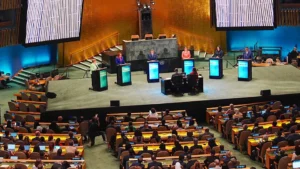
International organizations—the UN, the WTO, and others—were built on the premise that the Great Powers would provide the scaffolding for global cooperation. As the pillars of these organizations (the U.S. and Russia) become the primary disruptors of the order, these institutions risk becoming obsolete. We are witnessing the "de-globalization" of international law, where might—or rather, the ability to inflict local, asymmetric damage—makes right.
The "Paper Tiger" Paradox
The most dangerous aspect of this era is the uncertainty. When a great power is perceived as a "paper tiger," smaller actors may be emboldened to test the limits of their sovereignty. This leads to a higher frequency of localized conflicts, as the deterrent value of the superpower umbrella evaporates. The risk of miscalculation is at its highest point since the late 1940s.
Conclusion: A New Thucydidean Trap
We are living in the ruins of an era that we have not yet finished burying. The irony that Thucydides might observe today is that the superpowers have spent their strength in a quest for dominance that was never theirs to possess. By obsessing over the metrics of the past—territorial expansion, sphere of influence, and military volume—they have ignored the fundamental shift in the nature of power itself.
Power is no longer just about the ability to destroy; it is about the ability to build, to sustain, and to command legitimacy. In that regard, the giants of the 20th century have become the laggards of the 21st. As the dust settles on the current cycle of interventions, the world will not find a new hegemon waiting to take the reins. Instead, it will find a diverse, fragmented, and profoundly unpredictable landscape where the survival of the state depends less on its connection to a global superpower and more on its own capacity for resilience, innovation, and local cooperation.
The feet of clay are crumbling. Whether the golden heads follow depends on whether the old powers can learn to accept their limitations before the weight of their own history drags them down entirely.