The Transatlantic Mirage: Why Europe’s Appeasement Strategy is a Strategic Dead End
By Mark Leonard
July 15, 2026
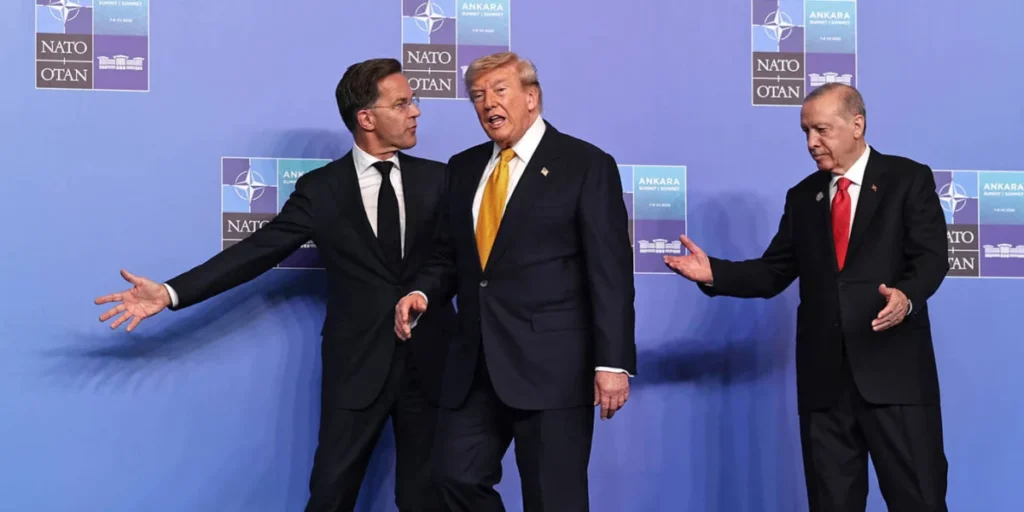
The recent NATO summit in Ankara, Turkey, has left the European political establishment in a state of fragile, performative relief. As the dust settles on the post-summit communique, leaders across the continent are patting themselves on the back for having navigated the mercurial whims of U.S. President Donald Trump. Yet, beneath this veneer of diplomatic success lies a profound, systemic vulnerability. By prioritizing the preservation of the transatlantic status quo at the cost of their own geopolitical autonomy, European leaders are not merely sacrificing their dignity—they are risking the very future of the Western security architecture.
The Ankara Summit: A Study in Managed Volatility
The NATO summit in Ankara was defined by the looming shadow of the White House. While the gathering avoided the total collapse that many feared, it was hardly a triumph of diplomacy. President Trump’s attendance was marked by his characteristic unpredictability, including an impromptu demand to acquire Greenland—a move that left Danish diplomats visibly unsettled—and a bewildering directive to halt trade with Spain, a NATO ally, citing vague grievances regarding industrial subsidies.
The fact that the alliance did not fracture under these pressures is being heralded as a victory by some, but this is a low bar for an organization tasked with the defense of the democratic world. The "relief" felt in Brussels, Berlin, and Paris is a symptom of a deeper malaise: a dependency on a U.S. executive who views traditional alliances not as foundational pillars of global stability, but as transactional instruments to be discarded or leveraged for short-term political gain.
A Chronology of Declining Trust
To understand the current precariousness of the NATO alliance, one must examine the timeline of the last eighteen months, which have seen a steady erosion of the post-Cold War consensus.
- January 2026: President Trump’s second-term inauguration speech explicitly signals a move toward a "National First" foreign policy, calling the Article 5 collective defense commitment "a relic of a bygone era."
- March 2026: Following a series of trade disputes, the U.S. administration imposes significant tariffs on German automotive exports, citing "national security" concerns.
- May 2026: The U.S. State Department announces a "Strategic Pivot" toward the Pacific, effectively signaling a reduction of U.S. naval presence in the Mediterranean and the Black Sea.
- July 2026 (Ankara Summit): The summit is held against the backdrop of the U.S.-Spain trade row. European leaders spend the majority of their private sessions attempting to "manage" the President’s focus, preventing him from withdrawing the U.S. from the alliance’s integrated military command structure.
Supporting Data: The Cost of Dependence
The quantitative reality behind the rhetoric is stark. According to recent reports from the European Defense Agency (EDA), while European NATO members have increased their aggregate defense spending by 4% over the last fiscal year, the distribution of this spending remains fragmented.
Europe currently relies on the United States for approximately 70% of its strategic airlift capabilities, 60% of its intelligence, surveillance, and reconnaissance (ISR) data, and a critical share of its missile defense architecture. When leaders focus their energy on "abasing themselves" to ensure the U.S. remains engaged, they are effectively diverting resources from the hard task of building a unified European defense pillar.
The economic fallout is equally damaging. The uncertainty created by the President’s threats to trade—most recently the nonsensical order to halt trade with Spain—has caused a 2.3% contraction in intra-alliance trade volume. This volatility undermines the very economic stability that NATO was designed to protect.
Official Responses: The Sound of Silence
The official reaction from the European Commission and the NATO Secretariat has been one of careful, if not cowardly, neutrality. In the aftermath of the Ankara summit, Secretary-General Mark Rutte issued a statement emphasizing "the enduring strength of the bond between our nations," a sentiment that feels increasingly hollow given the President’s public comments.
In Berlin, the Chancellor’s office has avoided direct confrontation, opting instead for a strategy of "strategic patience." This involves a series of bilateral concessions, ranging from increased commitments to U.S.-manufactured defense hardware to subtle shifts in European trade policies regarding China, intended to placate the White House.
However, behind closed doors, senior diplomats in Paris and Warsaw have expressed growing alarm. "We are playing a game of musical chairs," one senior French official noted on condition of anonymity. "The music will eventually stop, and we will find ourselves without a seat at the table if we continue to assume that the U.S. will always be there to lead."
Implications: The High Price of Nostalgia
The primary implication of the current European strategy is the normalization of instability. By refusing to confront the reality that the U.S. is no longer a reliable guarantor of European security, the continent’s leaders are leaving their populations vulnerable to the whims of an unpredictable American electoral cycle.
The Strategic Vacuum
The focus on appeasing Washington has created a strategic vacuum in Europe’s own neighborhood. As the U.S. turns its attention to the Indo-Pacific, Russia and other regional actors are observing the cracks in the Western facade. The inability of European leaders to speak with a single, authoritative voice has emboldened revisionist powers to test the limits of NATO’s commitment to its eastern flank.
The Erosion of Democratic Legitimacy
There is also a domestic political cost. When European citizens see their leaders prioritizing the "pleasure" of a foreign president over the economic interests of fellow Europeans—as seen in the treatment of Spain—the perceived legitimacy of the European project suffers. This fosters the rise of populist movements that, ironically, mirror the very isolationism seen in Washington.
Toward a Post-Transatlantic Future
If Europe is to survive this era of uncertainty, it must pivot from a posture of subservience to one of strategic autonomy. This does not mean the end of the transatlantic relationship, but it does mean the end of the unconditional transatlantic relationship.
- Hardened Defense Capabilities: Europe must move beyond the "NATO-plus" model and invest in a truly integrated European rapid reaction force that does not rely on U.S. logistics.
- Economic Sovereignty: The European Union must establish robust mechanisms to protect its member states from extraterritorial trade threats. The incident with Spain serves as a warning: economic policy must be insulated from the political volatility of foreign heads of state.
- Diplomatic Realignment: Europe must seek to build its own alliances, not as a replacement for NATO, but as a diversification of its security portfolio. This includes deeper cooperation with democratic partners in the Global South and the Indo-Pacific.
Conclusion
The "sigh of relief" in Ankara was not a sign of success; it was a sign of exhaustion. For decades, Europe has benefited from the protective umbrella of American power, but that era is coming to a close. To continue clinging to the "good old days" is not a strategy—it is a surrender.
European leaders must recognize that the most effective way to save the transatlantic alliance is not to grovel before a President who holds it in contempt, but to prove that Europe is a mature, capable, and self-sufficient partner. If they continue to prioritize dignity-sapping appeasement, they will find that when they finally look up from their desperate maneuvers, the alliance they sought to save will have long since evaporated, leaving them alone in a world they are unprepared to navigate.