The Silicon Valley Cold War: Apple, OpenAI, and the Escalating Feud Between Tech Titans
By PYMNTS | July 12, 2026
The fragile peace of the artificial intelligence sector has shattered. In a week defined by high-stakes legal maneuvering and vitriolic public outbursts, the giants of the tech industry have locked horns in a battle that threatens to reshape the landscape of innovation. As Apple launches a aggressive legal offensive against OpenAI, accusing the startup of systemic corporate espionage, the drama has spilled into the public sphere, reigniting one of the industry’s most bitter personal rivalries: the long-standing feud between OpenAI CEO Sam Altman and SpaceX/X owner Elon Musk.
The Legal Front: Apple’s Allegations of Corporate Espionage
The turmoil began in earnest last week when Apple filed a sweeping lawsuit against OpenAI, alleging that the AI powerhouse engaged in a calculated campaign to misappropriate trade secrets. The suit, which has sent shockwaves through the hardware and software development communities, centers on the conduct of two key OpenAI hires: Chief Hardware Officer Tang Tan and technical staff member Chang Liu.
Apple’s complaint paints a picture of a company desperate to bypass the arduous research and development phase of hardware manufacturing. According to the court documents, Tang Tan—formerly a high-ranking Apple executive—allegedly sent emails to his personal account containing sensitive information regarding Apple’s proprietary supply chain and manufacturing processes. Perhaps more damaging is the allegation that Tan encouraged Apple employees to bring physical prototypes and internal documents with them when interviewing for positions at OpenAI.
The allegations against Chang Liu are equally severe. Apple claims that Liu, a technical staffer, systematically downloaded confidential files from the company’s internal network. Furthermore, the suit alleges that Liu coached an existing Apple team member on how to bypass security protocols to exfiltrate proprietary data.
“We have no interest in other companies’ trade secrets,” an OpenAI spokesperson stated in a formal response to the filing. “We remain focused on building innovative technology that empowers people everywhere.” Despite this denial, the legal challenge poses a significant existential threat to OpenAI’s ambitions to move into the consumer hardware space, potentially stalling their integration of GPT models into physical devices.
The Personal Front: The Digital Duel Between Musk and Altman
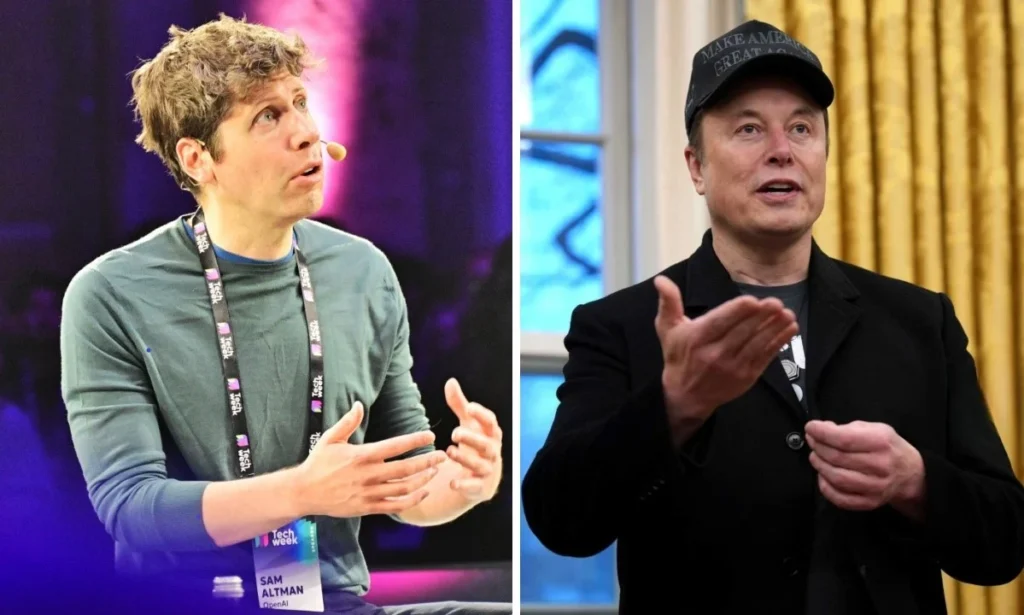
While the legal battle between Apple and OpenAI occupies the courtrooms, a more colorful, albeit hostile, exchange has unfolded on the social media platform X. Elon Musk, a co-founder of OpenAI who parted ways with the organization years ago, seized upon the news of the Apple lawsuit to launch a scathing verbal assault on his former colleague, Sam Altman.
Musk’s commentary was characteristically blunt. In a series of posts on X, Musk labeled the OpenAI chief “Scam Altman,” a moniker he has used previously to suggest that the company’s progress is built more on marketing hype and intellectual theft than genuine breakthrough innovation.
The exchange escalated quickly. After Musk posted a derogatory image of Altman with the caption, “I’m doing this because I love it,” and added, “He might literally love scamming more than any human alive,” Altman opted for a rare, public retort.
“Homeboy, you’re the one selling public market investors on short-term space datacenters,” Altman wrote, referencing Musk’s recent pivot toward orbital infrastructure.
Musk’s rejoinder was immediate and biting: “We start flying them next year. Maybe you can come see them if your parole officer approves.”
The digital sparring highlights a deeper tension: the transition from software-based AI to physical, infrastructure-dependent AI. As Altman prepares for the deployment of his latest models—the 5.6 “sol” iteration—he has framed Musk’s aggression as a sign of competitive anxiety. “There are a lot of benchmarks that suggest 5.6 sol is the best model in the world right now,” Altman noted on X, “but the most reliable way to tell is that Elon is obsessed with me again.”
A Chronology of Conflict
To understand the current volatility, one must look back at the historical arc of these relationships.
- 2015–2018: OpenAI is founded as a non-profit, with Elon Musk and Sam Altman working in close alignment to ensure AI development benefits humanity.
- 2018: Musk resigns from the OpenAI board, citing potential conflicts of interest with Tesla’s AI development.
- 2024: The simmering resentment reaches a boiling point when Musk sues OpenAI, claiming the company abandoned its non-profit mission to become a “de facto subsidiary” of Microsoft.
- May 2026: A jury rules in favor of OpenAI in the 2024 lawsuit, finding that Musk’s legal action was filed too late and appeared to be motivated by financial interests rather than genuine concern for the company’s charter.
- July 2026: Apple initiates its trade secret lawsuit, providing the catalyst for the current public war of words between Musk and Altman.
The Stakes: Infrastructure and Intellectual Property
The ongoing tensions are not merely personality clashes; they represent a fundamental pivot in the AI industry. As models become more powerful, they require massive compute power, driving companies toward new physical frontiers.
OpenAI’s push into hardware, the target of Apple’s current lawsuit, is an attempt to bridge the gap between pure software intelligence and tangible consumer applications. If Apple succeeds in proving that OpenAI’s hardware roadmap is built on stolen intellectual property, it could force a massive restructuring of OpenAI’s operations and potentially lead to significant regulatory intervention.
Simultaneously, Musk’s pivot to "space datacenters" reflects the physical constraints currently facing the AI industry. The sheer energy demands of modern AI models are straining terrestrial power grids. By moving infrastructure into orbit, Musk aims to bypass these limitations, a move that Altman clearly views as a strategic gamble.
Implications for the Future of AI
The broader implications of these disputes are profound. First, the industry is entering a "post-innocence" phase. The era of open collaboration that defined the early days of AI is being replaced by a defensive, litigious environment where every line of code and every manufacturing process is guarded with extreme prejudice.
Second, the relationship between hardware and software is becoming the primary battlefield for dominance. Apple, which has historically maintained a walled garden, views the poaching of its hardware expertise as an existential threat to its dominance in the consumer tech space. If OpenAI, armed with its GPT-5.6 models, can effectively replicate Apple’s hardware integration, the market equilibrium for personal computing will be permanently disrupted.
Third, the role of leadership in AI companies is under intense scrutiny. The personal animosity between Musk and Altman reflects a lack of consensus on the ethical and operational path forward for the industry. While Musk advocates for a more cautious, transparent, and distributed approach (at least in his rhetoric), Altman remains focused on rapid scaling and deep-tech integration, regardless of the institutional friction it creates.
Conclusion
As we look toward the remainder of 2026, the tech sector finds itself at a crossroads. The lawsuit from Apple serves as a stark reminder that the “move fast and break things” ethos of the software world encounters significant friction when it intersects with the physical manufacturing and intellectual property protections of established hardware titans.
Meanwhile, the public spectacle involving Musk and Altman provides a window into the egos driving the most powerful technologies in human history. Whether these conflicts lead to a more regulated, stable industry or a fractured, litigation-heavy environment remains to be seen. What is certain, however, is that the era of friendly, collegiate competition is over. In the race to build the future of intelligence, the titans are no longer looking for common ground; they are looking for a way to win at any cost.
For ongoing coverage of these legal developments and the evolving AI infrastructure market, subscribe to the daily PYMNTS AI Newsletter.