The Art of Uncertainty: What David Hockney’s Vision Teaches the Dismal Science
By Angus Armstrong
July 9, 2026
The passing of David Hockney last month has left a void in the landscape of contemporary art, but it has also provided a poignant moment for reflection across disciplines far removed from the canvas. Hockney, a titan of 20th and 21st-century English art, was defined by his refusal to accept a singular, static version of reality. In his sprawling, kaleidoscopic body of work, he demonstrated that the world unfolds through a multiplicity of perspectives—a truth that remains perpetually beyond the grasp of any single lens.
For the field of economics, a discipline that has long clung to the pretense of absolute certainty and mathematical precision, Hockney’s artistic philosophy serves as a necessary, if uncomfortable, mirror. If art is indeed an imitation of life, then the rigid models of the "dismal science" may be failing to account for the very complexity they seek to measure.
The Main Facts: A Life Beyond the Single Frame
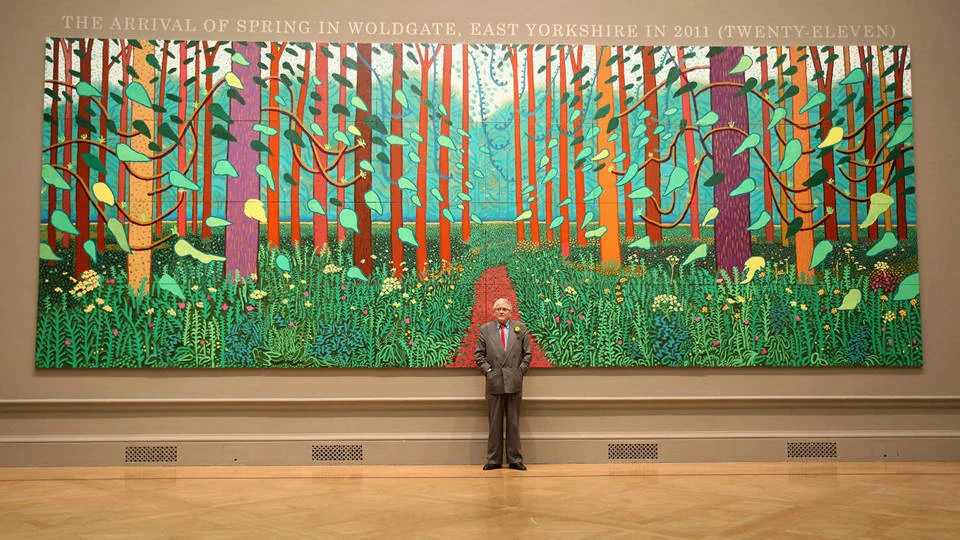
David Hockney’s career was a decades-long rebellion against the "single-point perspective"—the Renaissance technique that dictates everything in a scene must converge toward one vanishing point. Whether capturing the shimmering, artificial stillness of California swimming pools or the dappled, seasonal transformations of the Yorkshire Wolds, Hockney insisted that the eye is never still.
His work suggests that truth is not a fixed destination but a process of observation. By using multiple polaroids to create a "joiner" photo-collage, or by painting the same tree from six different vantage points at different times of day, Hockney exposed the limitations of the "snapshot" approach. Economists, who spend their careers attempting to distill the chaotic human experience into singular metrics like GDP growth, inflation targets, and consumer sentiment indices, are essentially trying to capture a moving river with a butterfly net.
Chronology: A Trajectory of Evolving Perspectives
To understand the weight of Hockney’s legacy, one must look at the evolution of his practice:
- 1960s – The Pop Art Emergence: Hockney moves to Los Angeles. He begins his iconic swimming pool series. These works utilize flat, bold colors to depict a world that feels both hyper-real and distinctly constructed, hinting that what we see is always filtered through cultural artifice.
- 1980s – The Photographic Experiments: Hockney begins his "joiner" series. By assembling dozens of individual photographs into a single work, he forces the viewer to jump across time and space, acknowledging that memory and perception are non-linear.
- 2000s – The Return to Nature: Hockney returns to Yorkshire, documenting the changing seasons. He employs digital tools, including iPads, to capture light in real-time. This period emphasizes that reality is not a static object, but a dynamic, temporal phenomenon.
- 2026 – The Final Reflection: Following his death, the retrospective analysis of his work highlights a lifelong commitment to the idea that the world is "too big" to be seen from a single angle.
Supporting Data: The Illusion of Economic Certainty
Economists have traditionally relied on "rational agent" models—the idea that individuals act with perfect information to maximize utility. Yet, the data suggests otherwise.
Behavioral economics has spent the last thirty years cataloging the ways in which human decision-making deviates from the "single-truth" model of the rational actor. Consider the following discrepancies:
- The Forecasting Gap: Since 2008, the variance between central bank growth forecasts and actual outcomes has widened significantly. When the "certainty" of predictive modeling is challenged by black-swan events, the models often fail to pivot, remaining anchored to outdated assumptions.
- Subjective Well-being vs. GDP: While GDP per capita in developed nations has generally trended upward over the last two decades, longitudinal surveys on "life satisfaction" show a stagnant or declining trend. This suggests that the "single truth" of economic growth is not translating into the lived experience of the population.
- The Complexity Index: Economic complexity theory, pioneered by researchers at Harvard and MIT, posits that economies are networks of knowledge. Data suggests that countries with higher "product space" connectivity are more resilient. This aligns with Hockney’s view: the more "vantage points" (or industries and knowledge bases) a society possesses, the more accurately it can navigate the shifting terrain of the global market.
Official Responses: Re-evaluating the Framework
The death of Hockney has sparked a quiet but meaningful conversation among policy-minded academics. At the recent London School of Economics symposium, Dr. Helena Vane noted: "We have spent far too long trying to build a ‘Theory of Everything’ in economics. Hockney reminds us that the observer is part of the system. When we measure the economy, we are not measuring a natural law like gravity; we are measuring a social construct that shifts the moment we look at it."
Conversely, proponents of traditional econometrics argue that simplicity is a virtue. "If we do not reduce the world to singular variables," one senior IMF analyst remarked, "we lose the ability to make actionable policy. We cannot manage an economy based on artistic intuition."
However, the consensus is shifting. There is a growing movement—sometimes called "Pluralist Economics"—that advocates for using multiple models simultaneously, much like Hockney’s multi-perspective canvases. By layering these models, economists can better understand the "depth of field" of a crisis, rather than focusing on a single, misleading focal point.
Implications: The Necessary Pivot to "Hockney-esque" Economics
What does this mean for the future of the profession? To move forward, economics must embrace three fundamental shifts:
1. From Certainty to Possibility
Instead of producing a single, "most likely" forecast, central banks and treasury departments should move toward "ensemble forecasting." This involves presenting a range of potential outcomes that reflect the inherent uncertainty of human behavior, much like a Hockney painting refuses to collapse into one vanishing point.
2. Acknowledging the "Observer Effect"
Just as Hockney’s presence in a landscape influenced how he painted it, the publication of economic data influences market behavior. Economists must move away from the myth of the "disinterested observer" and acknowledge that policy is a performative act. How we talk about the economy changes the economy itself.
3. Embracing the "Joiner" Approach to Data
Traditional statistics often aggregate data to the point of erasure. By utilizing granular, high-frequency data—what we might call "economic pointillism"—we can build a more textured understanding of inequality, localized inflation, and sectoral shifts. We need to stop looking at the economy as a single, flat image and start viewing it as a series of interconnected, overlapping realities.
4. Integrating the Humanities
Finally, the "dismal science" must invite the voices of artists, sociologists, and historians back into the room. If economics is the study of human choice, it cannot be stripped of the human condition. Hockney’s work is a testament to the idea that joy, perception, and beauty are just as "real" as interest rates and debt-to-GDP ratios.
Conclusion
David Hockney’s life was an invitation to look closer, look longer, and, most importantly, look differently. He showed us that the world is far more vibrant, complex, and unpredictable than our first glance suggests.
As economists, we would do well to heed this lesson. The quest for a single, unified truth is a comforting illusion, but it is one that leaves us ill-equipped to handle the volatility of the modern world. By adopting a "multi-perspective" approach, we can move toward an economic discipline that is not only more accurate but more human—a science that, like Hockney’s art, finds beauty and truth in the very things that refuse to be simplified.
As we move through the remainder of this decade, let us carry the spirit of the Yorkshire hills into the sterile halls of policy. Let us acknowledge that the map is not the territory, and that the beauty of the economy—much like the beauty of a Hockney landscape—lies in its infinite, unfolding layers.