SK Hynix’s $29 Billion U.S. Listing: A Strategic Pivot in the Global AI Arms Race
By PYMNTS
July 5, 2026
In a landmark move that promises to reshape the competitive landscape of the global semiconductor industry, South Korean giant SK Hynix is set to launch a historic $29 billion initial public offering (IPO) in the United States. Scheduled for July 10, 2026, this listing is not merely a mechanism for capital accumulation; it represents a calculated strategic maneuver by one of the world’s most influential chipmakers to secure its position at the center of the artificial intelligence (AI) revolution.
As the largest share sale ever conducted by a foreign firm on U.S. soil, the move signals a paradigm shift. For SK Hynix, the goal is clear: to leverage the unrivaled depth of American capital markets to challenge domestic rival Micron and solidify its foothold in the high-growth sector of high-bandwidth memory (HBM) chips—the essential architecture powering modern AI computing.
The Strategic Imperative: Why Now?
For years, SK Hynix has occupied a formidable, yet often overshadowed, position compared to its American competitor, Micron Technology. While SK Hynix has long been a leader in memory innovation, the sheer scale of the U.S. investment ecosystem has historically favored home-grown tech entities. By listing in the U.S., SK Hynix is effectively opening its doors to the world’s most aggressive AI-focused investors.
"We are in a time of extreme enthusiasm about chip stocks," says Daniel Morgan, senior portfolio manager at Synovus Trust. "It’s a good time to go and get the U.S. involved in your shares."
The move comes at a critical juncture. As AI models become increasingly complex, the demand for specialized memory—capable of feeding massive datasets into Graphics Processing Units (GPUs) at lightning speeds—has soared. SK Hynix has been a pioneer in this space, yet the capital requirements to maintain this lead are astronomical. By tapping into U.S. liquidity, the company is ensuring it has the "dry powder" necessary to outpace competitors in both R&D and manufacturing capacity.
A Chronology of the AI Chip Boom
The trajectory leading to this $29 billion listing has been defined by rapid acceleration and unprecedented capital expenditure:
- 2023-2024 (The Foundation): As generative AI gained mainstream traction, the semiconductor industry faced a sudden supply-demand imbalance. SK Hynix and Samsung began pivoting their production lines toward HBM, recognizing that the "bottleneck" of AI development was memory, not just processing power.
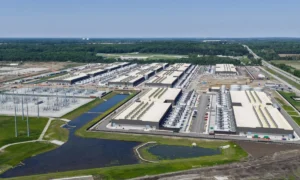
- Early 2026 (The Expansion): In a massive display of national industrial policy, SK Hynix and Samsung announced a combined $518 billion investment strategy. This capital is earmarked for the creation of massive semiconductor fabrication hubs in South Korea’s southwestern region, designed to create a "semiconductor cluster" that rivals any in the world.
- May 2026 (The Reality Check): Reports began to emerge questioning whether the AI hype cycle was outpacing real-world utility. Experts noted that while compute power was plentiful, the "harder half" of the equation—sustained, profitable demand from Main Street businesses—remained unproven.
- July 2026 (The IPO): SK Hynix formalizes its plan for the largest foreign listing in U.S. history, aiming to solidify its status as a primary supplier for the global AI infrastructure.
The Economics of the AI Bubble: A Balancing Act
While the excitement surrounding SK Hynix’s debut is palpable, the broader market remains cautious. The current AI infrastructure build-out is heavily funded by debt and equity markets, with tech titans like Microsoft and Google spending billions on hardware that has yet to see a corresponding, long-term return on investment (ROI).
Ed O’Gorman, CEO of River Wealth Advisors, provides a cautionary perspective: "Investors run the risk of stepping into something that’s potentially a speculative bubble. You have to be very careful investing in anything that’s up the way these stocks have climbed."
The concern is that if the flow of capital into AI projects slows—perhaps due to rising interest rates or a cooling of the "AI-first" corporate mandate—the semiconductor manufacturers, who have invested hundreds of billions in new fabrication facilities, could be left with significant overcapacity. The sustainability of the sector rests on the transition from experimental AI projects to mission-critical business applications.
Beyond the Hardware: The "Demand" Problem
The narrative that "whoever controls the compute controls the future" has dominated the last three years of market analysis. However, as noted in recent industry coverage, this perspective misses the most critical component of the value chain: the customer.
The next phase of AI is unlikely to be defined by the pure horsepower of a chip, but by whether ordinary businesses—accounting firms, nursing homes, insurance agencies, and logistics providers—can find tangible value in the technology.
In May 2026, the launch of Anthropic’s AI plugins for platforms like PayPal, Intuit, and Canva highlighted this shift. When AI integrates into specialized workflows—tasks that a local procurement manager or a financial analyst understands better than a Silicon Valley developer—that is where the real "sticky" demand begins. If AI cannot solve for the specialized needs of the global workforce, the hardware giants may find their current valuation multiples difficult to sustain.
Implications for the Semiconductor Industry
The SK Hynix listing serves as a litmus test for the global semiconductor market. If the IPO is met with strong, sustained demand from U.S. institutional investors, it will validate the current "all-in" strategy on AI hardware. Conversely, a lukewarm reception could signal that Wall Street is beginning to differentiate between companies with immediate, high-margin utility and those that are purely speculative.
The Competitive Landscape
For Micron, the presence of a freshly capitalized SK Hynix on the New York Stock Exchange represents a direct threat. SK Hynix will now have a public platform to communicate its technical roadmap directly to the same investors who currently back Micron. This will likely lead to increased transparency, more aggressive quarterly reporting, and perhaps a renewed focus on cost-efficiency and dividend policies to attract retail and institutional capital.
Geopolitical Dynamics
The South Korean government’s support for the $518 billion facility initiative demonstrates that semiconductors are no longer just a private-sector pursuit; they are a national security priority. By listing in the U.S., SK Hynix is bridging the gap between Korean industrial might and American financial depth, effectively creating a more integrated, cross-border semiconductor ecosystem.
Conclusion: A High-Stakes Bet on the Future
As July 10 approaches, the market is watching not just for the stock price performance of SK Hynix, but for what the offering says about the long-term outlook for the AI sector. Is this the beginning of a mature, sustainable era of technological integration, or is it the final peak of a speculative cycle?
For investors, the decision to participate in the SK Hynix IPO requires a nuanced understanding of both the hardware layer—the world of wafers, lithography, and memory bandwidth—and the software layer, where the actual value must be captured. The technology is undoubtedly astonishing, but as the market continues to evolve, the focus will inevitably shift from the chips themselves to the accountants, nurses, and managers who must ultimately use them.
The $29 billion question is whether the current investment frenzy is a precursor to a new digital industrial revolution or a cautionary tale of overextended capital. For now, the world’s eyes are on SK Hynix as it steps into the spotlight of the American equity market, ready to prove that its memory chips are the foundation upon which the next century of computing will be built.
For ongoing analysis of the semiconductor market and the shifting landscape of artificial intelligence, subscribe to the PYMNTS daily AI Newsletter.