Bitcoin ETFs Kick Off "Uptober" With $134.4 Million in Net Inflows as Macroeconomic Tailwinds Take Hold

WASHINGTON / NEW YORK — U.S. spot Bitcoin exchange-traded funds (ETFs) have wasted no time validating one of the crypto industry’s favorite historical axioms. Living up to the time-tested "Uptober" moniker, the investment vehicles logged a combined $134.4 million in net inflows over the first two trading days of October, according to data from Decrypt’s proprietary Bitcoin ETF tracker.
The positive start to the month demonstrates robust institutional resilience, arriving on the heels of a brief end-of-quarter pullback. As macroeconomic indicators shift in favor of risk-on assets, market participants are weighing whether this early momentum can carry Bitcoin toward historical price ceilings or if broader economic headwinds will ultimately cap the rally.
Main Facts
The opening days of October brought renewed institutional appetite for U.S.-listed spot Bitcoin ETFs, recovering quickly from late-September liquidations.
- The Inflow Breakdown: Spot Bitcoin ETFs pulled in $102.7 million on Thursday, followed by an additional $31.7 million on Friday, securing $134.4 million in net inflows to begin the month.
- Macro Catalyst: A cooling U.S. labor market—highlighted by the Bureau of Labor Statistics reporting a meager 29,000 jobs added in September and an uptick in unemployment to 4.2%—prompted a sharp recalibration of Federal Reserve expectations. CME FedWatch data showed market-implied odds of an October rate hike plummeting from 70% earlier in the week to just 14%.
- Price Action: Driven by the favorable macroeconomic backdrop, Bitcoin touched an intraday high of $87,173 on Friday, coming within striking distance of its September peak of $87,354 before stabilizing near the $85,000 threshold over the weekend.
- Milestone Figures: Cumulative net inflows since the inception of the spot Bitcoin ETFs now stand at an imposing $58.1 billion, with total net assets under management (AUM) hovering at $101.1 billion.
Chronology: From a September Slide to an "Uptober" Rebound
To fully understand the significance of October’s opening performance, market analysts are looking at the sequencing of institutional capital flows over the past several weeks.
Late September: The Inflow Streak Snapped
The shift into October followed an abrupt cooling-off period at the close of the third quarter. On September 30, U.S. spot Bitcoin ETFs shed $148.7 million in a single session. This sudden outflow abruptly terminated a lucrative nine-session inflow streak that had begun back on September 17.
Despite the late-month turbulence, September secured its place in the history books as the ETFs’ second-best performing month since October 2025. According to SoSoValue data, the vehicles accumulated a staggering $2.65 billion in net inflows over the course of the month, proving that institutional investors were aggressively positioning themselves ahead of the historical fourth-quarter crypto rally.

October 1–2: Rebuilding Momentum
As the calendar turned to October, institutional buyers immediately stepped back in. Thursday’s $102.7 million influx served as an emphatic statement that the late-September correction was merely a temporary consolidation phase rather than a structural shift in sentiment. Friday’s addition of $31.7 million cemented a successful opening week for the market sector.
Friday, October 3: The Jobs Report and Price Volatility
The defining moment of the week arrived on Friday morning with the release of the U.S. employment report. With job growth slowing dramatically to 29,000 and unemployment ticking upward to 4.2%, bond and equity markets reacted swiftly. Fixed-income traders aggressively priced out the likelihood of aggressive Federal Reserve monetary tightening, reducing the expected probability of an October rate hike to 14%.
Bitcoin responded immediately to the softening macroeconomic conditions, rallying to $87,173. While profit-taking subsequently pared some of those gains—bringing the asset down to a stable $85,000 by Sunday morning—the session proved that digital assets remain hyper-sensitive and responsive to shifting central bank dynamics.
Supporting Data and Market Metrics
An analysis of broader data sets reveals a nuanced picture of the digital asset ecosystem, characterized by massive institutional adoption on one hand and lingering caution regarding long-term price ceilings on the other.
- Historical Seasonality: "Uptober" is far more than a social media meme; it is a statistical reality rooted in Bitcoin’s decade-long trading history. According to Stephen Wundke of Algoz, Bitcoin has averaged an impressive 18% gain during the month of October over the past ten years.
- Year-to-Date Performance: Despite the multi-billion-dollar inflows recorded in September and the solid start to October, year-to-date net inflows for spot Bitcoin ETFs remain under $1 billion. This discrepancy is a direct result of substantial capital flight and heavy institutional outflows experienced earlier in the year during broader macroeconomic uncertainty.
- Prediction Market Sentiment: While spot ETF buyers are voting with their capital, prediction market participants display a more conservative outlook. Traders on Myriad, a prediction market platform owned by Decrypt’s parent company Dastan, currently place the odds at a remarkable 93% that Bitcoin will not establish a new all-time high over the course of 2026.
Official Responses and Expert Analysis
Market observers and industry experts have offered varied interpretations of the macroeconomic catalysts currently driving Bitcoin’s price action and institutional demand.
Stephen Wundke, speaking on the structural psychology driving traders at the start of the month, emphasized the shifting balance of risk. "Traders feel there is more upside currently than there is downside," Wundke noted in an interview with Decrypt. This sentiment explains why institutional allocators are willing to brush off short-term volatility in favor of positioning for historical fourth-quarter seasonality.
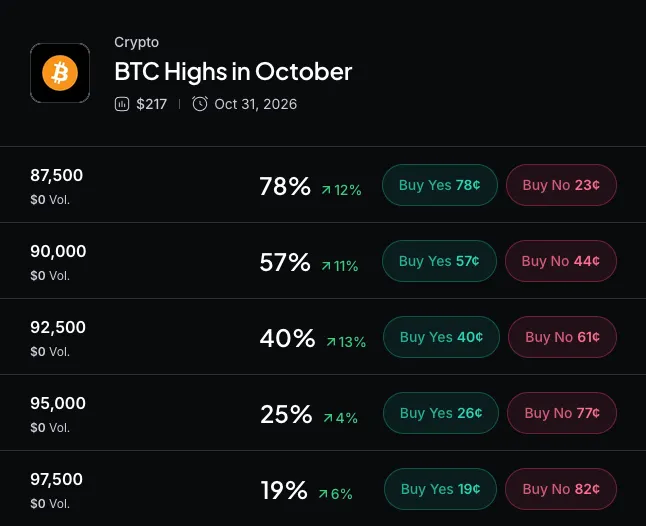
Macro analysts point out that the decoupling of risk assets from hawkish central bank fears has provided much-needed breathing room for crypto markets. By reducing the pressure on the Federal Reserve to implement aggressive rate hikes, the weaker-than-expected labor market has effectively removed a primary macroeconomic ceiling that had previously kept institutional capital on the sidelines.
Implications: What Lies Ahead for Bitcoin and ETFs?
The strong start to October carries profound implications for the remainder of the fourth quarter, serving as an early barometer for institutional sentiment heading into year-end portfolio rebalancing.
1. Relief from Macroeconomic Pressures
The primary takeaway from the recent jobs report is that the Federal Reserve may have successfully engineered a cooling labor market without triggering immediate systemic shocks, thereby lessening the impetus for further monetary tightening. For Bitcoin, which historically thrives in environments characterized by easing monetary policy and declining real yields, this shift removes a major headwind.
2. The Battle Between Institutional Inflows and Long-Term Resistance
While $134.4 million in net inflows over two days is a formidable start, the broader market remains caught in a tug-of-war. On one side are spot ETF issuers and institutional allocators driving cumulative net inflows to $58.1 billion and total assets under management to $101.1 billion. On the other side are cautious retail and derivatives traders—evidenced by the Myriad prediction markets—who remain skeptical of a parabolic breakout to new all-time highs in the near term.
3. Upcoming Macro Catalysts
Market participants will not have to wait long for the next major tests of this nascent "Uptober" rally. Two critical high-impact events loom large on the macroeconomic calendar:
- October 14: The release of the September Consumer Price Index (CPI) inflation report, which will provide further clarity on whether price stability is holding firm.
- October 28: The next scheduled Federal Reserve policy meeting, where central bankers will officially decide the trajectory of interest rates moving forward.
Until these milestones are reached, Bitcoin’s ability to sustain its position near the $85,000 mark—backed by steady spot ETF accumulation—suggests that institutional demand remains a resilient floor for the world’s leading cryptocurrency.