Strategic Shift: Crusoe and Boom Supersonic Part Ways in Landmark Energy Deal
In a high-stakes realignment of the AI infrastructure sector, Denver-based data center giant Crusoe has officially terminated its partnership with Boom Supersonic to utilize the aerospace firm’s specialized natural gas-fired turbines. The dissolution of this deal, which was originally valued at $1.25 billion, marks a significant turning point for both companies as they navigate the volatile, energy-intensive landscape of the artificial intelligence boom.
The news comes on the heels of Crusoe securing a massive $3.9 billion funding round, solidifying its status as a titan in the AI data center market. While the move is framed by both parties as a strategic pivot rather than a failure, it raises questions about the future of bespoke power solutions in an industry increasingly defined by the desperate, immediate need for massive electrical capacity.
Chronology of a Failed Partnership
The relationship between Crusoe and Boom Supersonic was born from a convergence of necessity and innovation. Crusoe, which began its journey in 2018 as an innovative bitcoin miner utilizing stranded natural gas from oil fields, has evolved into a key architect of the AI age. Its mission—to build “AI factories from the power up”—placed it at the center of the computational gold rush, notably constructing massive data centers for tech giants like OpenAI and Oracle.
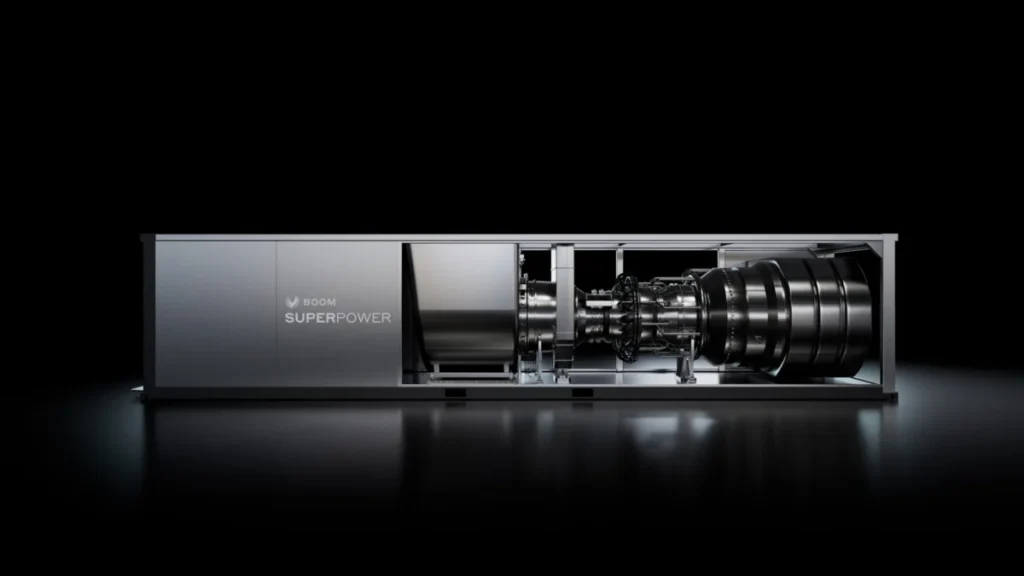
Boom Supersonic, meanwhile, is best known for its ambitious pursuit of the "Overture," a supersonic passenger jet. In an effort to diversify revenue streams and subsidize the massive R&D costs of aviation, Boom launched a stationary power business last year. Their flagship product, the "Superpower" turbine, is a technological marvel, sharing approximately 80% of its components with the "Symphony" engine currently being developed for the Overture.
The partnership was announced with great fanfare, with Crusoe signing on as the launch customer for the Superpower program. The agreement, valued at $1.25 billion, covered the acquisition of 29 units of the 42-megawatt turbines, with an initial delivery timeline slated for 2027. However, the synergy between the two companies proved fragile. By late 2026, the contractual arrangement had unraveled.
The Logic of the Split: An Industry Pivot
The dissolution of the contract was confirmed by Boom Supersonic CEO Blake Scholl in a candid post on X (formerly Twitter). Scholl, who maintained a supportive tone toward his former partners, provided clarity on why the deal ceased to be viable.
"The TL/DR is that turbines are no longer part of Crusoe’s near-term primary power mix at Abilene and other sites, so a launch partnership just didn’t make sense," Scholl wrote. He noted that while the partnership helped shape the early development of the Superpower turbine, Crusoe’s evolving energy strategy simply outgrew the need for this specific aerospace-derived solution.
Crusoe’s official response mirrored this sentiment, emphasizing the necessity of operational agility. "We build AI factories from the power up, and we’re bringing new campuses online across the country, powered by innovative energy sources," a company spokesperson stated. "As our portfolio grows, we stay flexible, choosing the energy solutions that are right for each site as its needs evolve—including turbines, along with wind, solar, batteries, and the grid."
For Crusoe, the decision appears to be one of architectural optimization. As they scale, the company is finding that a "one-size-fits-all" approach to power—even when that power comes from cutting-edge turbine technology—may not be as efficient as a diverse, site-specific energy strategy.
Supporting Data: The Energy Hunger of AI
To understand the stakes of this breakup, one must look at the sheer scale of the energy demand involved. AI data centers are notoriously power-hungry, requiring a constant, high-reliability flow of electricity that many regional grids are struggling to provide.

Crusoe’s current infrastructure footprint is immense. Their 1.2-gigawatt facility in Abilene, Texas, serves as a primary hub for OpenAI and Oracle. While this facility primarily relies on the regional grid, it utilizes gas-turbine power plants for critical backup, ensuring that operations remain uninterrupted during grid fluctuations. Furthermore, Crusoe is currently in the process of constructing a 900-megawatt data center in the same region for Microsoft, which is specifically designed to run on on-site gas turbines.
Boom Supersonic, despite losing its high-profile launch customer, remains bullish on its power business. Scholl revealed that the company is on track to deliver approximately 250 megawatts of Superpower capacity to other clients next year, with an aggressive target of 1 gigawatt by 2028. This suggests that while the Crusoe deal fell through, the market for high-performance, modular, gas-fired power remains robust.
Implications for the Tech and Energy Sectors
The separation of Crusoe and Boom carries significant implications for the intersection of aerospace, energy, and big tech.
1. The Challenge of "Hardware-as-a-Utility"
Boom Supersonic’s attempt to pivot from aerospace engineering to industrial power generation was an bold play. The company raised $300 million last year specifically to commercialize its stationary turbine business, with the goal of using the profits to fund the development of the Overture jet. Losing a launch customer of Crusoe’s stature is a setback, but it also highlights the difficulty of marketing aerospace-grade technology to the industrial sector, where reliability, maintenance, and long-term cost-to-kilowatt ratios are scrutinized with extreme rigor.
2. Crusoe’s "Energy Agnostic" Evolution
Crusoe’s decision suggests a move toward becoming an "energy-agnostic" integrator. By opting for a mix of grid power, renewables, and localized generation, the company is hedging its bets against the volatility of the energy market. Their commitment to building out "AI factories" requires an extreme level of risk management; if a single technology provider—like Boom—faces production delays or technical hurdles, the risk to the data center’s uptime is unacceptable.
3. The Future of On-Site Power
The rise of the "data center as a power plant" is perhaps the most significant trend in the infrastructure space. As AI demand continues to skyrocket, tech companies are increasingly moving away from being mere grid consumers and toward becoming independent energy producers. Whether through natural gas turbines, modular nuclear reactors, or massive battery arrays, the data centers of the future will effectively be private power utilities.
Looking Forward: A Shared Future?
Despite the professional separation, both firms appear to be on a trajectory of continued growth. Crusoe is flush with capital and continues to be the preferred infrastructure partner for the world’s most powerful AI labs. Boom Supersonic continues its push to disrupt aviation, with the Superpower turbine business serving as a critical financial bridge to its long-term aerospace goals.
Blake Scholl’s parting comments suggest that the door is not permanently closed. "The future is long, and we look forward to potentially teaming up if/when turbines become part of their primary power mix," he noted.
For now, the break serves as a reminder that the AI revolution is as much a war of logistics and energy as it is a battle of algorithms. As the dust settles on this $1.25 billion deal, the industry will be watching closely to see how Crusoe powers its next wave of growth and whether Boom can prove the viability of its aerospace-derived power solutions in a market that demands nothing less than perfection.