The Architecture of Erasure: How Colonial Food Policies Weaponized Nutrition Against Indigenous Sovereignty

Each autumn, as the harvest season approaches, grocery stores and suburban doorsteps are adorned with bundles of multicolored maize. Marketed as "ornamental corn," these decorative husks are presented as symbols of harvest bounty and rustic charm. Yet, beneath the aesthetic veneer lies a painful irony: what is now a seasonal decoration was once the lifeblood of Indigenous civilizations—a complex, nutrient-dense staple that colonial powers systematically sought to replace with state-sanctioned commodity rations.
The transformation of Indigenous foodways from a pillar of sovereignty to an object of decoration is not merely a cultural shift; it is the visual legacy of a deliberate strategy of control. By restricting access to traditional food systems and replacing them with processed commodities, colonial governments utilized nutrition as a weapon of assimilation, forever altering the physical and cultural landscape of Native North America.
The Chronology of Dispossession: From Sovereignty to Rations
The assault on Indigenous food systems was not an incidental byproduct of colonization; it was a foundational component of it. To understand the current state of food insecurity within many Indigenous communities, one must examine the systematic dismantling of their traditional dietary autonomy.
The Era of Scarcity (18th – 19th Century)
For millennia, Indigenous peoples across the continent operated sophisticated agricultural and foraging systems. In the Great Plains, the buffalo provided not only food but the structural materials for survival. In the Southwest and Mexico, the cultivation of the "Three Sisters"—corn, beans, and squash—created a symbiotic agricultural cycle that sustained large, healthy populations.
Colonial expansion, however, recognized that true subjugation required total dependency. In the 19th century, the United States government adopted a policy of intentional starvation to force tribes onto reservations. The mass slaughter of the American bison—a campaign encouraged by military leaders like General Philip Sheridan, who famously remarked that the buffalo hunters were "destroying the Indians’ commissary"—was a calculated act of ecological warfare. By eradicating the primary food source, the state ensured that Indigenous survival became contingent upon government handouts.
The Residential School Era and the Commodity Pipeline
As tribes were confined to reservations, the federal government pivoted to the use of "commodity foods." These rations were often of poor quality, consisting of refined flour, sugar, lard, and canned meats—foods that stood in stark contrast to the nutrient-dense, diverse diets of hunter-gatherer and agriculturalist societies.
This policy was formalized through the Indian Residential School system. In these institutions, children were stripped of their linguistic and cultural ties, including their relationship to traditional foods. The introduction of government-issued rations served two purposes: it created a logistical dependency on the state and physically weakened the population, making them more susceptible to the diseases and social malaise that accompanied forced assimilation.
Supporting Data: The Biological Cost of Assimilation
The impact of this dietary shift is quantifiable. Traditional Indigenous diets were characterized by high fiber, lean proteins, and a wide array of micronutrients derived from wild-harvested greens, game, and non-GMO heirloom crops. The shift to a "commodity diet"—high in refined carbohydrates and saturated fats—has had catastrophic health implications.
- Metabolic Disruption: According to data from the Indian Health Service, Indigenous populations in the United States face significantly higher rates of Type 2 diabetes compared to the general population. This is not a genetic inevitability, but a direct consequence of the "nutrition transition" forced upon these communities.
- The Loss of Biodiversity: The burning of amaranth grains by conquistadors in Mexico and the systematic destruction of heirloom seed varieties were acts of intellectual and biological erasure. Amaranth, a "superfood" with higher protein content than wheat, was outlawed because of its sacred significance. The loss of such crops stripped Indigenous peoples of their agricultural self-sufficiency, forcing a reliance on colonial trade networks.
- The Psychological Toll: As noted by multidisciplinary artist Brandon S. Copley, whose work explores the trauma of these historical policies, the process of forced assimilation was a multi-generational assault on the soul. The "civilizing" mission relied on the belief that Indigenous knowledge was inferior. When a child was forbidden from eating the foods of their ancestors, the state was not just feeding a body; it was colonizing a memory.
Perspectives from the Frontlines: The Art of Remembrance
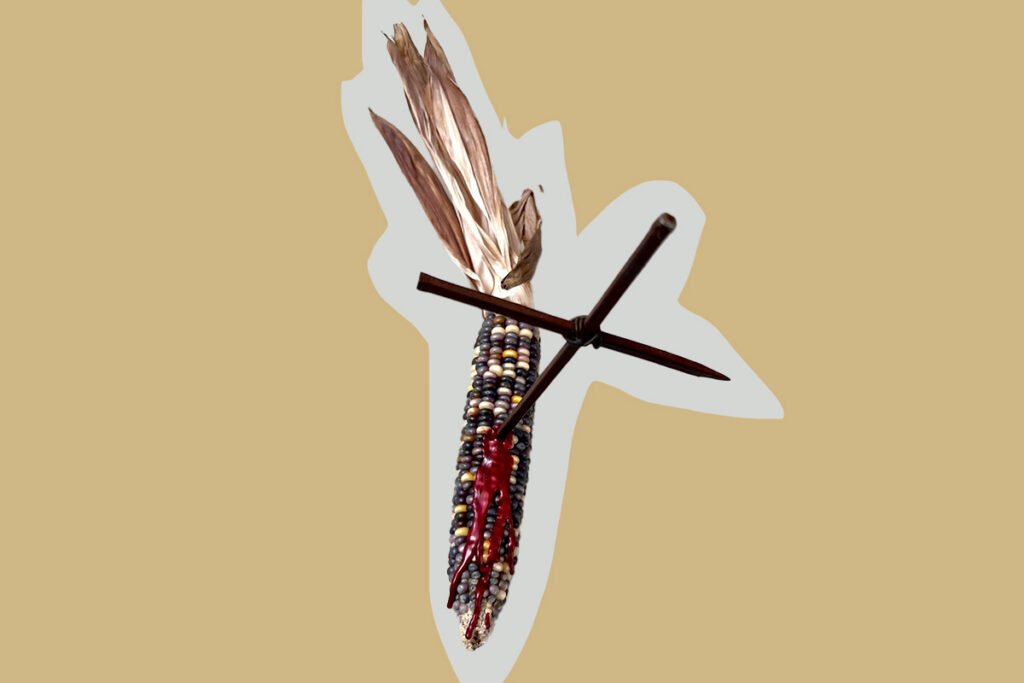
Brandon S. Copley, a two-spirit artist of Seneca and Maidu descent, occupies a unique position in this discourse. Through his assemblage art, Copley uses found objects to reconstruct the narrative of Indigenous resilience. His work—which often features symbolic representations of maize and colonial iconography—serves as a visual critique of the "ornamental" treatment of Indigenous history.
"Struck by the discovery of child remains found on Indian residential school grounds," Copley notes, "my journey began by processing grief through creativity." For Copley, the act of using symbolism, such as a metal cross piercing an ear of colorful maize, is a way to confront the blood-stained history of the "civilizing" project. By recontextualizing these items, he challenges viewers to see beyond the autumn aesthetic and recognize the historical trauma embedded in the American food supply chain.
Implications for Modern Food Sovereignty
The legacy of these policies persists in the "food deserts" that plague many reservations today. With limited access to fresh, affordable produce, many communities remain trapped in the same cycle of commodity dependency established over a century ago. However, a growing movement for Food Sovereignty is currently working to reclaim the narrative.
Reclaiming the Land and the Diet
Modern Indigenous-led organizations are reclaiming traditional agricultural methods, reintroducing heirloom seeds, and establishing community-led food systems that bypass the commodity pipeline. This is not merely a health initiative; it is a political act of decolonization.

The Institutional Responsibility
For non-Indigenous institutions, the path forward requires acknowledging the systemic nature of these historical injustices. Institutional charities that continue to provide "handouts" without considering the cultural and nutritional appropriateness of the food are often perpetuating the same paternalistic patterns of the past. Real support, as championed by organizations like the Nonprofit Quarterly, involves funding Indigenous-led solutions that empower communities to feed themselves.
Conclusion: Beyond the Aesthetic
When we look at the colorful corn on a neighbor’s porch this autumn, we must ask ourselves what we are seeing. Are we seeing a decoration, or are we seeing the surviving remnants of a complex agricultural genius that was once systematically targeted for destruction?
The history of colonial food policy is a history of erasure. Yet, the persistent presence of these crops—and the voices of artists like Brandon S. Copley—remind us that the culture they represent was never fully extinguished. True reconciliation in the context of food requires more than just acknowledging the past; it demands a radical restructuring of the present to ensure that Indigenous communities have the sovereignty to define their own relationship with the land and the nourishment it provides.
As we move forward, the mission remains clear: to protect the voices that challenge the "civilizing" myths of the past and to support the reclamation of a future where food is once again a symbol of life, rather than a tool of control.