The Great Transformation: Why AI and Change Management Dominate the Future of Accounting
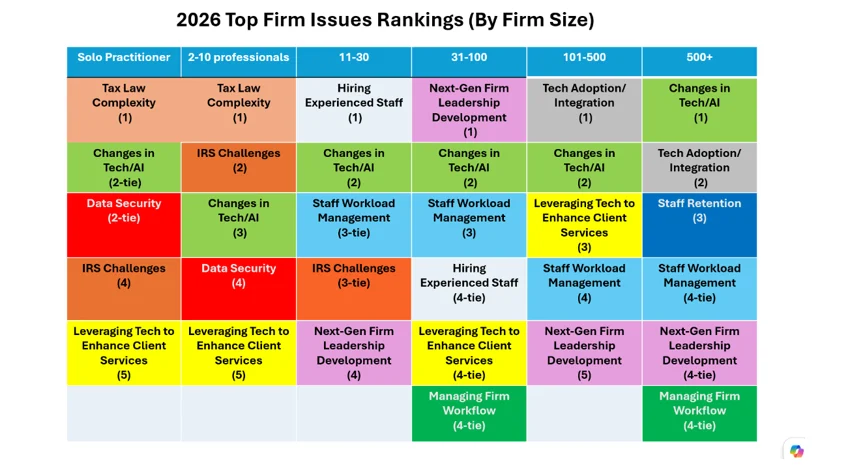
The accounting profession stands at a pivotal crossroads. As the digital landscape evolves at an unprecedented pace, the traditional boundaries of CPA firms are being redrawn by the twin forces of artificial intelligence and shifting operational paradigms. According to the latest CPA Firm Top Issues Survey conducted by the AICPA’s Private Companies Practice Section (PCPS), change management—specifically regarding the integration of technology and AI—has surged to become the preeminent issue for accounting firms over the next five years.
This seismic shift marks a departure from historical concerns. While talent acquisition and regulatory compliance have long been the pillars of concern for practitioners, the current climate dictates that survival and growth are now intrinsically linked to a firm’s ability to pivot toward a technology-first business model.
Main Facts: The New Reality of Practice
The survey, which captured insights from 629 participants between April 20 and May 22, reveals a profession in the midst of a technological awakening. The findings underscore that "change management" is no longer a buzzword; it is the fundamental challenge of the modern firm.
In a notable contrast to the 2024 survey results, where technology-related concerns were largely peripheral, the 2026 data shows AI and tech-driven transformation occupying the top two spots for almost every firm size. For the largest firms (those with more than 500 employees), tech adoption and the integration of AI are now the undisputed primary concerns.
This transformation is not uniform, however. The AICPA’s decision to categorize firms into six distinct size groups reflects an acknowledgment that a solo practitioner’s daily reality—centered on tax law complexity and IRS friction—is worlds apart from the strategic, enterprise-level hurdles faced by firms with hundreds of employees.
A Chronological Perspective: From Niche Concern to Top Priority
To understand the gravity of this shift, one must look at the recent history of the profession.
2024: The Era of Talent Scarcity
Two years ago, the primary narrative in the accounting world was the "war for talent." The 2024 Top Issues Survey identified finding qualified staff as the single greatest threat to firm viability. Technology was a secondary consideration, appearing only in the lists of the smallest and largest firms, and even then, it rarely breached the top four rankings. At that time, AI was viewed more as a curiosity than a catalyst.
2025: The Year of Experimentation
Throughout the following year, firms began experimenting with generative AI for basic tasks—drafting emails, summarizing meeting notes, and preliminary data analysis. The initial fear of displacement began to evolve into a realization that AI could augment, rather than replace, human expertise.
2026: The AI Integration Mandate
Today, the conversation has shifted from "What is AI?" to "How do we integrate this at scale?" The current survey results demonstrate that AI is no longer a peripheral tool; it is a core operational requirement. The speed with which this transition has occurred is unprecedented in the accounting sector, pushing firms to overhaul their internal training, client service models, and quality management systems simultaneously.
Supporting Data: Dissecting the Firm-Size Divide
The AICPA survey results provide a nuanced map of how different segments of the profession are prioritizing their future.
Technology vs. The Human Element
While AI dominates the broader discussion, the "people" side of the business remains a non-negotiable priority. The data reveals a clear segmentation:
- Solo Practitioners and Small Firms (up to 10 employees): These firms continue to grapple with the "front-line" realities of the profession. Tax law complexity remains their top concern, followed closely by data security and IRS challenges. For these practitioners, the burden of change management is deeply personal, as they lack the large IT departments of their mid-sized counterparts.
- Mid-Sized Firms (11–100 employees): This cohort is caught in the "growth trap." Firms with 11–30 employees identify hiring experienced staff as their primary hurdle, while those with 31–100 employees are hyper-focused on next-gen leadership development. They are attempting to scale their firms while simultaneously implementing new tech stacks.
- Large Firms (101–500+ employees): These organizations are leading the charge in technology. For these firms, tech adoption and AI integration are consistently the top two issues. They have the capital to invest in sophisticated AI tools, but they face the massive challenge of managing staff workloads during the transition.
The Uniformity of Pressure
Despite the varying priorities, a few constants emerged across the board:
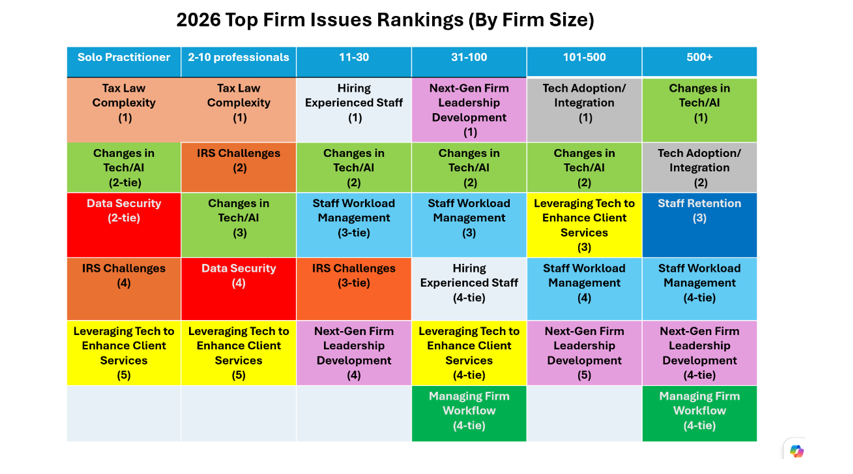
- Staff Workload Management: Ranked in the top four for all four larger firm groups.
- Staff Retention: Cracked the top five for all groups except solo practitioners.
- Quality Management (QM) Systems: Bolstering these systems is now a strategic priority for four out of the six firm categories.
Official Responses: The View from the AICPA
Lisa Simpson, CPA, CGMA, and Vice President of Firm Services at the AICPA, believes these results tell a story of necessary evolution.
"The top issues for firms tie into the transformation we’re seeing in technology, people skills, and operating models," Simpson stated in the official news release. She emphasized that while the adoption of AI is the headline, the real work lies in integration. "We know keeping up with rapid developments in AI and technology capabilities can be a challenge, but the survey also revealed that there are challenges with integrating technology and leveraging it to enhance service offerings."
Simpson also offered a vital reminder for a profession currently enamored with automation: "On the people side, we’re seeing more focus on reframing job skills, managing staff workload, developing leaders, and evolving services to meet client expectations. Regardless of technology capabilities, accounting is still a people business."
Implications: The Future of the CPA Firm
What does this data mean for the next five years? The implications for the profession are profound.
1. The Death of the Generalist
As AI takes over repetitive data-entry and basic compliance tasks, the value proposition of the CPA is shifting toward advisory services. Firms that fail to pivot from "compliance-based" to "consulting-based" models will likely struggle to retain staff who feel their work is being commoditized by software.
2. Leadership and Culture as Differentiators
Because AI is becoming a baseline requirement, it will eventually become a commodity. The true differentiator for firms will be their culture and their ability to lead. The fact that next-gen leadership development and staff workload management are consistently high-ranking issues suggests that firms are recognizing that software cannot manage people, mentor juniors, or build client trust.
3. The Quality Management Imperative
With AI handling more of the heavy lifting in audit and tax preparation, firms must rethink their quality management systems. Automated systems create new risks—specifically, the risk of "black box" logic or data bias. The industry must move toward a model of "human-in-the-loop" oversight, where AI provides the efficiency, but the CPA provides the accountability and professional judgment.
4. A New Definition of "Qualified Staff"
The survey indicates a shift in required job skills. The firms of tomorrow will not just need accountants who understand GAAP; they will need accountants who understand data architecture, prompt engineering, and cybersecurity. The "reframing of job skills" mentioned by Simpson will be the defining challenge for human resources departments in accounting firms through 2030.
Conclusion: Embracing the Shift
The 2026 CPA Firm Top Issues Survey is more than just a ranking of anxieties; it is a blueprint for the future. The profession is clearly moving away from the era of manual, labor-intensive processes and toward a more agile, technology-driven future.
For the solo practitioner, the path forward involves mastering the tools that simplify tax complexity and secure client data. For the large firm, it involves the complex orchestration of AI integration and human capital management. While the challenges are significant, they also represent a historic opportunity to redefine the value of the CPA. Accounting is, as Simpson noted, a people business—but the people who succeed in this new era will be those who harness the power of the machine to better serve their human clients.
As firms look toward the next five years, the message from the profession is clear: Adaptability is no longer a competitive advantage—it is the baseline for relevance.